
Listen to this article
Your guest just landed at Sangster International.
She’s from Toronto. No roaming plan. She switches off airplane mode, hoping your offline guest guide loads. It drops. She’s standing at the arrivals hall, luggage in hand, trying to open your check-in instructions on Airbnb.
The page won’t load.
She doesn’t know the property address. She doesn’t know the Wi-Fi password. She doesn’t know what to do if the gate code doesn’t work.
And you? You’re in Kingston. It’s 10 PM. Your phone is about to die.
This is not a horror story. It’s a Tuesday in Montego Bay.
I’m Simmy Sterling, Content Alchemist at Digisolly, and I want to talk about something most short-term rental hosts in Jamaica haven’t considered yet. Your guest information system is only as strong as the network carrying it. When that network fails, and in Jamaica it does fail, your hospitality falls apart at exactly the moment it matters most.
There’s a better way. It’s called offline-first hospitality, and it’s simpler to build than you think.
Why “It’s All in the App” Is Not Enough for Jamaican Hosts
Airbnb, VRBO, and Booking.com are magnificent platforms. They’re how guests find you, trust you, and pay you. But they were not built for Caribbean connectivity realities.
According to DataReportal’s 2025 Digital Report (datareportal.com), Jamaica’s mobile internet adoption continues to grow, but network reliability across rural parishes and coastal resort areas remains inconsistent. Guests travelling from high-connectivity markets like the United States, Canada, and the UK routinely underestimate how different the experience can be.
Network congestion is real, especially during high season. Storm-related outages affect access for hours, sometimes days. And roaming costs keep many international guests on minimal data until they reach your Wi-Fi.
Here’s what that means for your property: if your only guest information delivery system is a link inside the Airbnb app, you are gambling with your review score every single time.
Guest Information Delivery — Offline Resilience Comparison
The fix is not complicated. It’s a mindset shift. Stop thinking of guest information as something you send. Start thinking of it as something your guest carries.
What an Offline-First Guest Guide Actually Looks Like
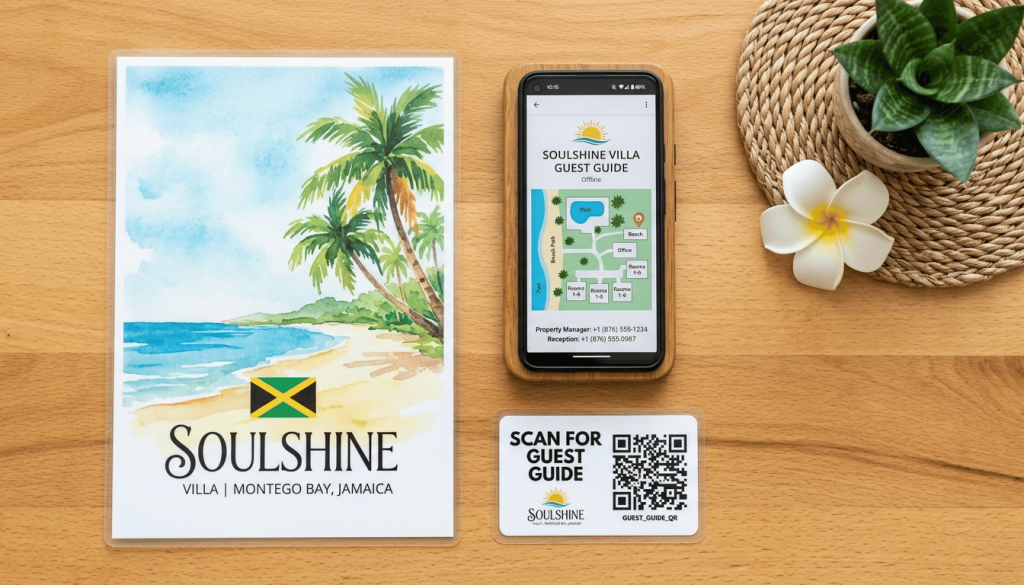
Let’s get specific. An offline-first guest guide is a collection of your property’s most critical information, packaged so guests can access it without a live internet connection.
Your offline guest guide answers three categories of questions.
Arrival questions. Where is the property? What’s the address, the gate code, the parking situation? If a guest is navigating from MBJ to a villa in Hanover, they need that address loaded in Google Maps before they leave the airport, not when they’re already on the B8 highway with no signal.
In-stay questions. Where’s the Wi-Fi password? How does the air conditioning work? Is the pool heated? What time is checkout? Which days does the housekeeper come? A well-built guest guide answers every question before the guest has to ask it.
Emergency questions. What do guests do if the electricity goes out? Which number do they call? What’s the nearest hospital or clinic? Where is the closest pharmacy? In Westmoreland and Hanover, where Hurricane Melissa hit hardest in October 2025, hosts who had printed emergency protocols and offline-accessible contact sheets were able to keep guests calm and informed while networks were overwhelmed. The lesson from that experience applies to every corner of the island.
Related Reading: The Hurricane Melissa Effect — Why Digital Resilience Is Now Essential in Jamaica
An offline-first guide is not a backup. It is the primary delivery system. Everything else is a supplement.
The Three-Layer Guest Information Stack
Here’s a framework that works for Jamaican hosts at every budget level.
Layer 1: The Printed Property Folder
Old-fashioned? Yes. Effective? Completely. A well-designed property folder placed at the entrance or on the kitchen counter requires zero technology to use. It costs you a print job. It never goes offline.
Include: full property address and GPS coordinates, door and gate codes, Wi-Fi name and password, appliance instructions, local emergency numbers, host WhatsApp number, and your top five local restaurant recommendations with addresses written out in full. Not just names. Addresses.
A guest who can hand a written address to a taxi driver on the North Coast Road is a guest who feels taken care of.
Layer 2: The Cached Digital Guide
This is where you build trust with the tech-forward traveller. A cached offline guest guide is a web page, Google Doc, or PDF that guests download before they leave the airport Wi-Fi zone.
The trick is in the instruction. Your pre-arrival message should include one clear action: “Before you leave the airport, please open this link and let it load fully. It will save offline so you can access it anywhere on the island.” Simple. Most guests will do it.
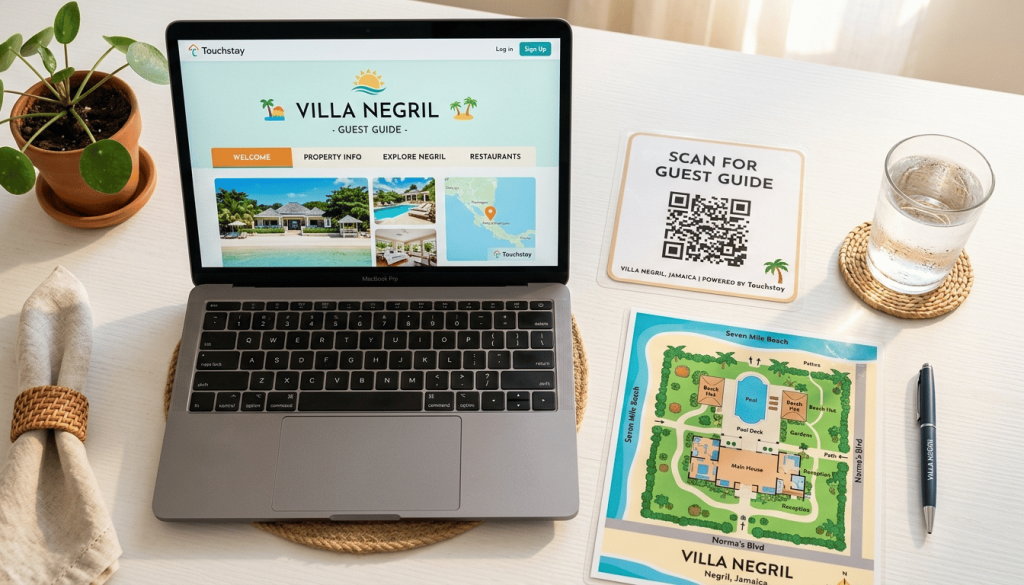
Offline guest guide tools that make this easy include Notion (which has offline capabilities), Google Docs (downloadable as PDF), Hostfully (a dedicated guidebook platform), and Touchstay, which is purpose-built for short-term rental welcome books and works offline once loaded.
Layer 3: The QR Code at the Property
Place a laminated QR code linking to your offline guest guide at the entrance and in the kitchen. When the guest connects to your Wi-Fi for the first time, the QR code takes them to your full digital guide, which then caches on their device. From that point on, even if the internet drops, the guide is accessible.
This is the layer most Jamaican hosts skip. It’s also the one that generates the ‘so thoughtful and professional’ review comments.
Most Common Guest Complaints Related to Arrival and Information Access, Caribbean Short-Term Rentals (2024)
41%
33%
28%
24%
19%
Hostfully State of the Short-Term Rental Industry Report 2024 (Hostfully.com)
Local Guides That Actually Help (and the Ones That Don’t)
Here’s an uncomfortable truth about most Airbnb local guides. They’re written for the host’s convenience, not the guest’s reality.
“Check out Scotchies in Ocho Rios!” Great. Where is it? What do you order? Is it open on Sundays? Can a vegetarian eat there? Does the taxi driver know it by that name or does everyone call it something else locally?
Vague recommendations are worse than no recommendations. They create work for the guest.
A useful local guide is specific. It names the dish. It includes the phone number. It tells the guest whether to book ahead or walk in. It warns them about the parking situation. It says “ask for Miss Paulette, she’ll sort you out” when that’s actually the experience.
That level of specificity is also what makes your guide cacheable and shareable. Guests photograph it. They send it to the people travelling with them. They reference it three days into the trip. That’s the guide doing work for you long after check-in.
Local Guide Quality — Weak vs Strong Guest Information
The difference between column two and column three is a five-star review.
How This Connects to Your AI Search Visibility
Here’s where it gets interesting for hosts who want to be found by AI travel tools, not just Airbnb search.
When ChatGPT, Perplexity, or Google’s AI Overview recommend a Jamaican villa or guest house, they are pulling from structured, factual information about your property. The completeness and specificity of your property description, your location data, and your guest reviews all feed into how AI systems understand and represent your listing.
A host who has built a comprehensive offline guest guide is, almost by accident, creating exactly the kind of detailed, fact-dense content that AI search systems favour.
Your offline guest guide makes the property address specific. The amenities are listed in detail. The local area is described with named locations, distances, and context. That’s AEO (Answer Engine Optimisation) applied to hospitality, and it happens naturally when you build for the guest experience first.
Related Reading: What Is Answer Engine Optimisation (AEO)? A Guide for Jamaican Businesses
Related Reading: Why Every Jamaican Small Business Needs a Strong Online Presence in 2026
Building Your Offline Guest Guide: A Checklist
Before you publish your next listing or check in your next guest, work through this.
The Printed Folder
- Full property address written out in full, including parish
- GPS coordinates (copy from Google Maps)
- Gate code, door code, safe code if applicable
- Wi-Fi name and password in large, readable type
- Host WhatsApp number
- Emergency contacts: police (119), ambulance (110), nearest hospital with address
- Nearest pharmacy with opening hours
- At least five local restaurant recommendations with address and phone number
- Appliance instructions for air conditioning, TV, hot water system, and stove
- Checkout instructions and key return process
- Local taxi contact and approximate fare to town centre
The Digital Guide
- Hosted on a stable platform (Touchstay, Hostfully, Google Doc, or Notion)
- Includes all printed folder content plus photos
- Can be downloaded or cached for offline access
- Pre-arrival message instructs guests to load it before leaving airport Wi-Fi
- Updated seasonally (check phone numbers, restaurant hours, road conditions)
The QR Code
- Generated and linked to your digital guide URL
- Laminated and placed at entrance and kitchen counter
- Tested on both Android and iOS before guests arrive
The AI Visibility Layer
- Property description on Airbnb/VRBO includes specific amenities, distance to named landmarks, and parish location
- Google Business Profile set up and updated if managing multiple properties or operating as a business entity
- Guest reviews mention specific location names and amenity details (encourage this naturally in your thank-you message)
Frequently Asked Questions About Offline Guest Guides
What is an offline-first guest guide for short-term rentals in Jamaica?
An offline-first guest guide is a property information document that guests can access without a live internet connection. It typically includes check-in instructions, property details, local recommendations, and emergency contacts. It can be a printed folder, a cached web page, or an offline-capable digital guidebook. Jamaican hosts use these to ensure guests can navigate arrival and in-stay situations even when mobile data or Wi-Fi is unavailable.
How do I make my Airbnb guest guide available offline?
Three methods work well for Jamaican hosts. First, create a printed property folder and leave it at the property. Second, share your digital guide link in your pre-arrival message and instruct guests to open and fully load it before leaving an airport or hotel Wi-Fi zone, which caches it on their device. Third, use a platform like Touchstay or Hostfully, which are built specifically for offline-accessible short-term rental guidebooks.
Do I need a website to have an offline guest guide?
No. A well-structured PDF sent by email, a saved Google Doc, or a printed document all work as offline guest guides. A dedicated guidebook platform or a simple Progressive Web App gives you more features, but the core content is more important than the technology delivering it.
What information should every Jamaican host include in their guest guide?
At minimum: the full property address including parish, GPS coordinates, all door and gate codes, Wi-Fi details, your WhatsApp number, emergency contacts including the nearest hospital and police station, transport options and approximate costs, at least five local restaurant recommendations with addresses, and checkout instructions. Anything a guest might need to ask you about should already be answered in the guide.
How does an offline guest guide improve my Airbnb reviews?
Guests who feel informed and supported from the moment they arrive leave better reviews. Specific praise in reviews, such as ‘the guide was incredibly detailed’ or ‘we had everything we needed even when the Wi-Fi was slow,’ also helps your listing appear more credible to future guests and to AI travel tools that surface property recommendations. The correlation between detailed, specific guest information and positive review language is well documented in Hostfully’s annual short-term rental industry surveys.
So What’s Your Next Step?
Your guests deserve to feel looked after before they ever knock on your door.
The offline guest guide is not a nice-to-have. It’s the difference between a five-star arrival experience and a frantic WhatsApp thread at 11 PM.
Get Your Digital Foundation Built
Ready to build a digital presence for your property that works even when the network doesn’t? Digisolly helps Jamaican hosts set up smart, reliable information systems that keep guests happy and your reviews strong. Let’s build your system. [Link: digisolly.com]
Schedule a Free Strategy Call
Not sure where to start? Book a free 30-minute call with Digisolly. We’ll look at your current guest communication setup and build a plan that works for your property and your parish. No pressure, just honest advice. digisolly.com

Simone “Simmy” Sterling is the Content Alchemist at Digisolly, writing about AI-first digital strategy for Jamaican small businesses. She turns the complexity of AI search, Answer Engines, and digital visibility into plain language that actually makes sense, and actually gets used. Think less tech jargon, more real talk over a good cup of Blue Mountain.