
Hurricane Melissa exposed a structural vulnerability in how Jamaican businesses communicate with customers: those relying solely on phone lines and a single social media account went unreachable when infrastructure failed, while businesses with active websites, up-to-date Google Business Profiles, and WhatsApp Business accounts remained findable and contactable throughout the disruption. Digital resilience — having multiple, independent channels through which customers can find and reach you — is no longer a marketing advantage; for Jamaican businesses, it is a business continuity requirement. The practical implication is that building your online presence is not just about growth; it is about remaining operational when the predictable disruptions that affect Jamaica every year arrive.
Listen to this article
Picture this. It’s a Tuesday morning somewhere in western Jamaica. The storm has passed. The sun is already doing what the Jamaican sun does — acting like nothing happened. A business owner unlocks her shop door, checks the shelves, finds everything intact. She survived Melissa with minimal damage. She’s relieved.
Then she picks up her phone.
Forty-seven missed calls. Twenty-three WhatsApp messages she couldn’t receive because the network was down for three days. A Google Business Profile (GBP) she never finished setting up, so when customers searched for her during the disruption to find out if she was open, they found nothing. And three reviews she just got, all saying the same thing: “Couldn’t reach them. Don’t know if they’re still operating.”
She didn’t lose her business in the storm. She lost customers, quietly, while she was still standing.
I’m Simmy Sterling, Content Alchemist at Digisolly, and I think about this scenario a lot. Because it captures the thing most conversations about digital resilience in Jamaica miss entirely. It’s not about dramatic loss. It’s about the slow, silent cost of being unreachable when it matters most.
That’s what Hurricane Melissa revealed. And that’s what this article is about.
What Digital Resilience in Jamaica Actually Means
Let’s define this properly, because “digital resilience” gets thrown around a lot and it deserves more than a buzzword.
Digital resilience is your business’s ability to remain visible, reachable, and trusted online, even when physical infrastructure fails. That means your phone lines are down but customers can still find your hours on Google. Your office is closed but your website tells people exactly what’s happening. Your team can’t take calls but WhatsApp Business is handling inquiries automatically.
It’s not about fancy tech. It’s about having systems that don’t depend on everything working perfectly to keep working at all.
For Jamaican small businesses, this matters more than it does almost anywhere else. According to the World Bank, Jamaica ranks among the Caribbean territories most exposed to natural hazard risk, with a combination of hurricane, flood, and earthquake vulnerability that creates recurring disruptions to infrastructure. Add to that the well-documented challenges with consistent electricity and broadband access in some parishes, and you have a business environment where “normal” is often interrupted.
Digital resilience in Jamaica, then, is the difference between a disruption and a disaster.
The Melissa Effect: What the Storm Actually Exposed
Hurricane Melissa wasn’t just a weather event. It was a stress test. And for many Jamaican businesses, the results were humbling.
The storm exposed three specific vulnerabilities that pure physical preparedness can’t protect against.
Vulnerability 1: Single-channel communication. Businesses that relied primarily on a landline or one mobile number were effectively silent during the disruption. When networks were overloaded or down, those businesses became unreachable. Not because they were closed. Not because they didn’t care. Simply because they had no backup.
Vulnerability 2: Outdated or absent online information. When customers couldn’t call, they turned to Google. And what many found was incomplete profiles, wrong hours, outdated addresses, or nothing at all. According to BrightLocal’s Consumer Review Survey, 98% of consumers used the internet to find information about a local business in 2023. During a disruption, that number doesn’t go down. It goes up, because calling isn’t an option.
Vulnerability 3: No trust signals during silence. A business that goes quiet during a crisis — even involuntarily — loses customer confidence fast. Research from Edelman’s Trust Barometer consistently shows that silence from a brand during uncertainty is interpreted as instability. For a small business owner in Montego Bay, Jamaica, who simply lost her internet connection for four days, that silence wasn’t a choice. But to customers, it looked like one.
This is the Melissa Effect. Not just physical damage, but reputational and commercial damage caused by digital absence at the worst possible moment.
The Three Pillars of Digital Resilience for Jamaican Businesses
Here’s the good news. Building digital resilience in Jamaica doesn’t require a big budget, a tech team, or a complicated strategy. It requires three things, done well.
Pillar 1: Visibility (So Customers Can Find You)
Your Google Business Profile is not a nice-to-have. After Melissa, it became something closer to essential infrastructure. A complete, updated GBP means that when a customer in Portmore searches “pharmacy open near me” during a disruption, your name appears with current hours, a phone number, your address on Google Maps, and recent photos.
That’s not marketing. That’s survival.
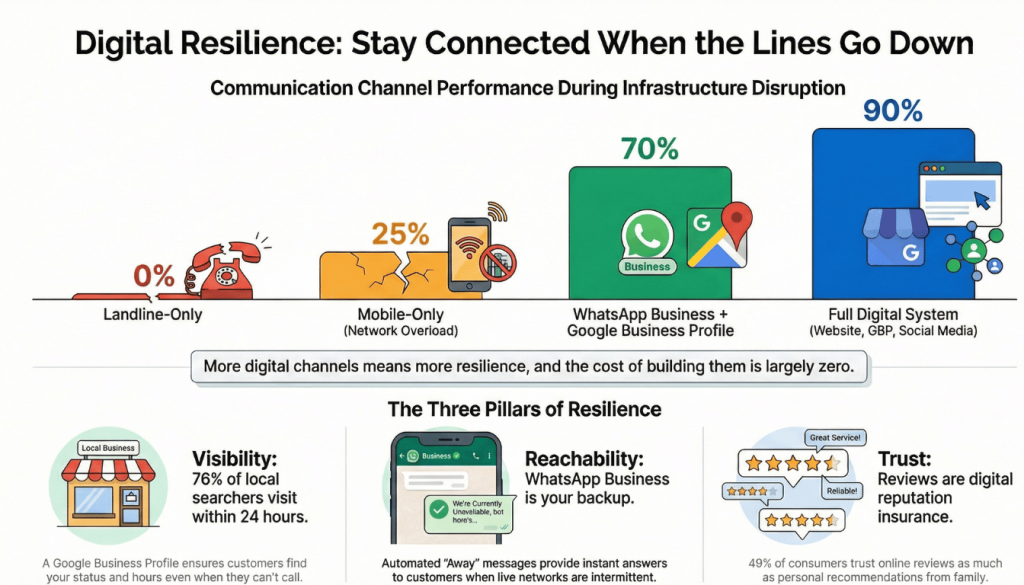
According to Think with Google, 76% of people who search for something nearby visit a business within 24 hours. During and after a storm, when people are stressed, time-poor, and making fast decisions, that statistic matters enormously. Being visible at that moment is worth more than any ad spend.
Pillar 2: Reachability (So Customers Can Reach You)
Every Jamaican business owner with a smartphone already has access to one of the most powerful customer communication tools on earth. WhatsApp Business is free, it’s used by the vast majority of Jamaicans as a primary communication channel, and it has features that most businesses are simply not using.
Automated greeting messages. Away messages that explain your hours and situation. Quick replies for your most common questions. A product or services catalogue.
During Melissa, businesses with WhatsApp Business set up properly could still receive and respond to messages when network conditions allowed. Customers could see their last message. They knew the business was alive, even if communication was intermittent. That’s reachability under pressure.
The point is not that WhatsApp fixes everything. The point is that relying on a single landline as your only contact method is, as of 2026, a decision that puts your business at unnecessary risk.
Pillar 3: Trust (So Customers Choose You When Conditions Normalise)
Here’s the part most people overlook. The damage from digital absence during a storm often shows up weeks later, not during the storm itself.
Customers move on. They find someone else. They leave the unanswered question in the back of their mind: “That business went quiet. Are they reliable?” And then they just… don’t come back.
Online reviews are your trust infrastructure. According to BrightLocal, 49% of consumers say they trust online reviews as much as personal recommendations from friends and family. For a Jamaican business that couldn’t answer the phone for three days, a bank of 30 positive Google reviews is the thing that keeps a customer from writing you off entirely.
Visibility gets you found. Reachability gets you heard. Trust gets you chosen. Digital resilience in Jamaica is the combination of all three.
Before and After: What Digital Resilience Looks Like in Practice
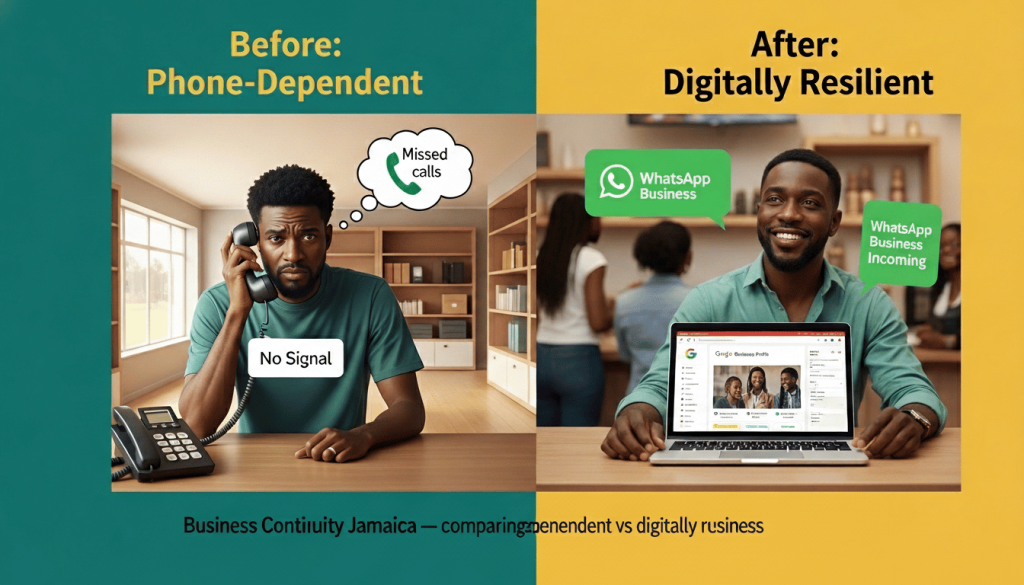
| Scenario | Phone-Dependent Business | Digitally Resilient Business |
|---|---|---|
| Storm disrupts phone network | Completely unreachable | GBP shows hours, WhatsApp messages queue |
| Customer searches on Google | Incomplete or empty profile | Full profile with hours, photos, reviews |
| Customer asks “Are you open?” | No way to answer | Auto-reply on WhatsApp Business answers instantly |
| Post-storm trust signals | Silence. Uncertainty. | Reviews, posts, updated information visible |
| Revenue impact | Lost sales, lost customers | Maintained visibility, faster recovery |
| Setup cost | None required | Mostly free tools, a few hours of setup |
Source: Compiled from BrightLocal Consumer Review Survey 2024, Think with Google Local Search Insights 2024, and World Bank Caribbean hazard risk data 2023
The Practical Digital Resilience Checklist for Jamaican Small Businesses
This is what building digital resilience in Jamaica actually looks like, broken into steps a busy business owner can do this week.
☑ Claim and complete your Google Business Profile. Make sure your hours, address, phone number, and photos are current. This takes about 30 minutes and costs nothing. Set up your GBP here.
☑ Set up WhatsApp Business. Add an automated greeting, an away message, and your key business information. Download WhatsApp Business free here.
☑ Post an update on your GBP this week. Even a simple “We’re open and operating normally” post tells Google and customers alike that your business is active. Aim for one post per week.
☑ Ask your last five customers for a Google review. Not a fake one. A real one. Send them a direct link. Reviews are your digital reputation, and they work when you can’t.
☑ Check that your business name, address, and phone number are consistent across your website, Facebook, Instagram, and Google. Inconsistency creates confusion and damages your search visibility.
☑ If you have a website, make sure it lists your current hours, services, and a way to contact you. A website that hasn’t been updated since 2022 is not a trust signal. It’s a doubt signal.
☑ Consider a simple “contact us” or “book an appointment” form on your website. This means customers can reach you even when phone lines are down.
Look, I know this list feels long when you’re running a business every day. The honest answer is: you don’t have to do it all at once. Start with your Google Business Profile. That’s the single highest-impact move you can make for digital resilience in Jamaica right now.
If you’d rather have someone set it up properly while you focus on your customers, that’s exactly what Digisolly does. Let’s talk about your setup.
What’s Coming Next: Digital Resilience Is About to Get More Important, Not Less
Here’s a trend worth watching. AI search tools like Google’s AI Overview, ChatGPT, and Perplexity are increasingly being used by customers to find and evaluate local businesses. These tools don’t just look at your website. They pull information from your Google Business Profile, your reviews, your social media, your mentions across the web.
A business with strong digital foundations is one that AI can find, verify, and recommend. A business with weak digital foundations is one that AI simply doesn’t know exists.
Digital resilience in Jamaica, as of 2026, is not just about surviving the next storm. It’s about being visible and trusted in the next era of search. The businesses that build good digital habits now are the ones that will be recommended by AI tools tomorrow.
That’s a longer conversation. But it starts in exactly the same place: getting your basics right.

The Bottom Line on Digital Resilience in Jamaica
Look, I’ve walked you through a lot. But here’s the one thing I want you to hold onto.
Digital resilience in Jamaica isn’t a luxury reserved for big companies with big budgets. It’s a set of practical habits, most of them free, that keep your business visible and reachable when the conditions around you are anything but ideal.
Hurricane Melissa made the invisible costs visible. Businesses lost customers, not to better competitors, but to silence. And the difference between the businesses that recovered quickly and the ones that are still rebuilding trust wasn’t physical. It was digital.
Your customers are searching for you right now. Make sure they can find you, reach you, and trust you. Not just on a perfect Tuesday morning, but on every morning that comes after.
So What’s Your Next Step?
Get Your Digital Foundation Built Ready to build a digital presence that works even when infrastructure doesn’t? Digisolly sets up smart, reliable online systems for Jamaican businesses. Let’s build your system.
Schedule a Free Strategy Call Not sure where to start? Let’s talk. Book a free 30-minute strategy call with Digisolly. We’ll look at your current setup and create a custom plan. No pressure, just honest advice. Schedule your call.
Get Your Online Presence Audit Want to know exactly where you stand online right now? Our free Digital Presence Audit shows you where customers can and can’t find you, and what it’s costing you. Get your audit.
Sources & References
BrightLocal. (2024). Local Consumer Review Survey 2024. brightlocal.com
Think with Google. (2024). How People Search for Local Businesses. thinkwithgoogle.com
World Bank. (2023). Caribbean Disaster Risk Profile. worldbank.org
Edelman. (2024). Edelman Trust Barometer. edelman.com
Google Business Profile Help Centre. (2026). How to optimise your Business Profile. support.google.com
STATIN. (2024). Information and Communications Technology Report. statinja.gov.jm
Caribbean Telecommunications Union. (2023). Digital Infrastructure Resilience in the Caribbean. ctu.int
Keep Reading
- Offline-First Website for Contractors Jamaica – Stay Visible During Grid Failures
- Offline Guest Guides for Jamaica Villas – Deliver Guest Info Without a Signal
- Voice Search for Trade Services Jamaica – The Hands-Free Way to Win More Jobs

Simone “Simmy” Sterling is the Content Alchemist at Digisolly, writing about AI-first digital strategy for Jamaican small businesses. She turns the complexity of AI search, Answer Engines, and digital visibility into plain language that actually makes sense, and actually gets used. Think less tech jargon, more real talk over a good cup of Blue Mountain.