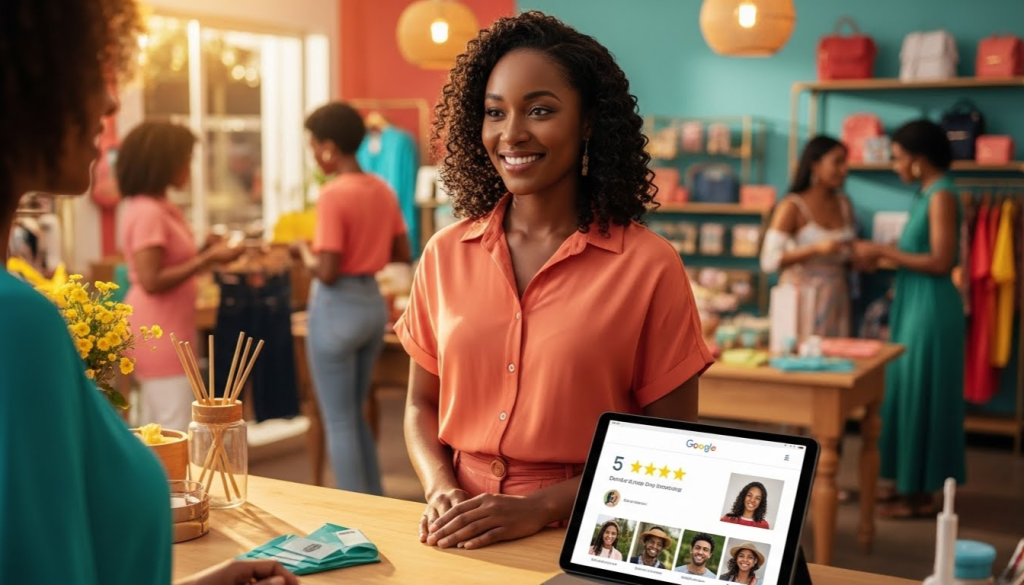
Before committing to a Jamaican business, most customers verify three things: genuine reviews from people they recognise or trust on Google, visible proof that the business is real and currently active (photos, a recent social post, a functional website), and a clear, low-friction way to make contact — ideally via WhatsApp. Inconsistent information across platforms, no reviews, or a website that looks neglected signals untrustworthiness, and in a market where reputation and word-of-mouth drive the majority of purchasing decisions, those trust signals cost real business every day. The businesses that convert the most enquiries into paying customers are the ones that make verification easy at every touchpoint before the first conversation even begins.
Listen to this article
What happens when a customer in New Kingston searches for a hair salon and sees two completely different businesses?
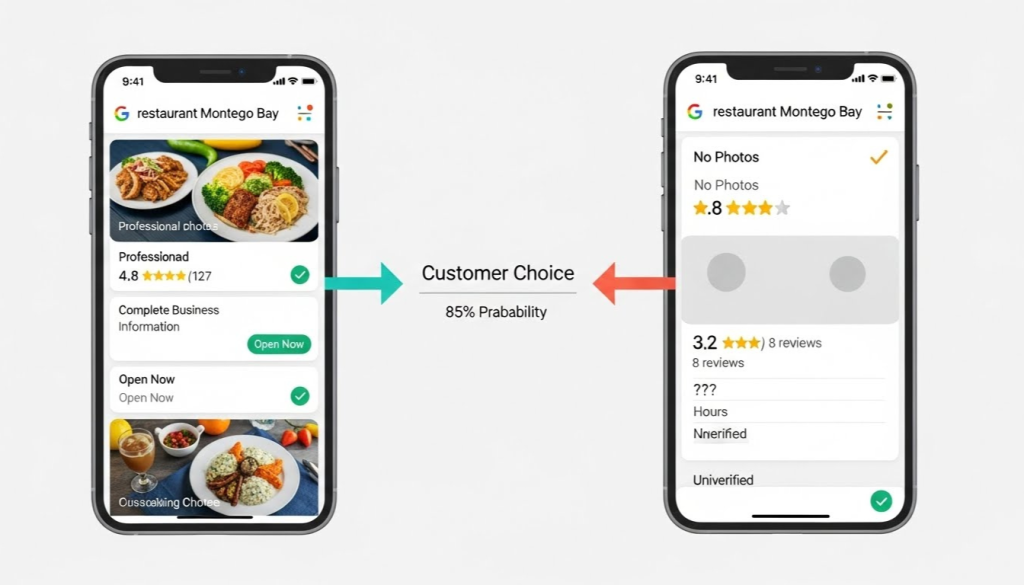
Two businesses pop up. The first one has professional photos, 47 reviews averaging 4.7 stars, clearly listed services with prices, and updated hours posted three days ago. The second one? A blurry logo, 4 reviews from 2022, no prices, and hours that say “Closed” even though they’re actually open.
Which one do you think gets the call?
If you said the first one, you’re right. And here’s what most Jamaican business owners don’t realize: this decision happens in about 8 seconds. Eight seconds for a potential customer to look at what you’ve put online and decide whether you’re worth their time and money.
What makes a customer choose your business over the competitor right next door?
I’m Jordan Reid, a digital strategy advisor at Digisolly. I work with a team led by our founder, who brings over 20 years of business experience across multiple industries in Jamaica. Throughout this article, I’ll show you the specific jamaican customer behavior patterns that determine whether someone chooses your business or scrolls past to your competitor.
Here’s what we’ve learned: Customer decisions aren’t random. They’re based on specific buyer trust factors that you can actually control. The problem is, most business owners don’t know what these factors are, so they’re losing customers without even knowing why.
Let me show you exactly what customers are looking for.
The 8-Second Decision: How Jamaican Customers Really Choose
What happens when a customer in New Kingston searches for a hair salon and sees two completely different businesses?
Two businesses pop up. The first one has professional photos, 47 reviews averaging 4.7 stars, clearly listed services with prices, and updated hours posted three days ago. The second one? A blurry logo, 4 reviews from 2022, no prices, and hours that say “Closed” even though they’re actually open.
Which one do you think gets the call?
If you said the first one, you’re right. And here’s what most Jamaican business owners don’t realize: this decision happens in about 8 seconds. Eight seconds for a potential customer to look at what you’ve put online and decide whether you’re worth their time and money.
When someone searches for a business like yours, you have about 8 seconds to convince them you’re worth contacting. That’s not much time.
According to research from BrightLocal’s consumer review survey, 98% of consumers read online reviews for local businesses, and 87% won’t consider a business with less than a 4-star rating. In Jamaica, where mobile device usage for internet access reaches 87% according to STATIN’s 2024 Digital Connectivity Report, these decisions happen even faster because people are searching on smaller screens while they’re on the move.
This pattern plays out across Jamaica every single day. A mechanic shop in Spanish Town might provide excellent service, but if their competitor down the street has 43 reviews and professional photos while they have 2 reviews from three years ago and no photos, guess who gets the business?
The service quality might be identical, but here’s the thing: potential customers can’t experience your excellent work until they choose you first. And they won’t choose you if you don’t look trustworthy online.
What Happens in Those 8 Seconds
When a potential customer finds your business online, their brain is rapidly scanning for answers to these questions:
- Can I trust this business?
- Are they actually open and available?
- Do they offer what I need?
- What do other people say about them?
- Can I easily contact them?
Every buyer trust factor Jamaica customers look for is really just an answer to one of these questions. And if you’re not providing clear answers, customers move on. They don’t give you the benefit of the doubt. They just scroll to the next business.
Trust Factor #1: Reviews (The #1 Decision Maker)
Let’s be direct: reviews are the single most important factor in jamaican customer behavior when it comes to buying decisions.
According to Google’s research, 63.6% of consumers say they are likely to check online reviews on Google before visiting a business location. In Jamaica, where word-of-mouth has always been important, online reviews have become the digital version of asking your friend, “Do you know anywhere good?”
The Numbers That Matter
Research across local search behavior shows clear patterns in how review counts affect customer decisions:
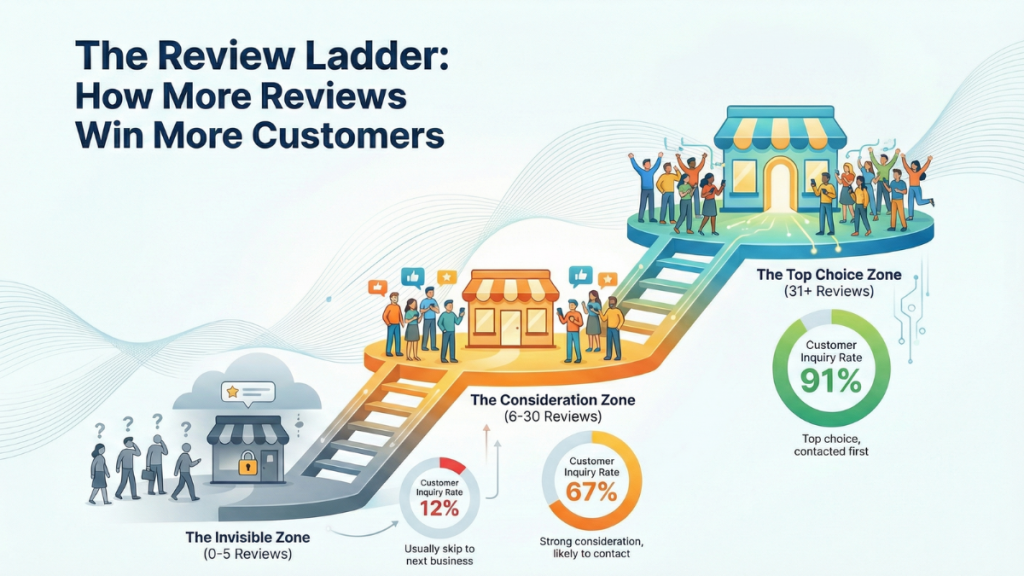
Source: Compiled from BrightLocal Consumer Review Survey 2024, Google Local Search Insights 2024, and local business performance studies
The pattern is clear: more reviews equal more customer trust, which equals more business.
But here’s what surprises most business owners: it’s not just about having a perfect 5.0 rating. A business with 35 reviews and a 4.6 rating will typically get chosen over a business with 8 reviews and a 5.0 rating. Why? Because customers know that more reviews mean more people have actually used the business. It’s more trustworthy.
What Jamaican Customers Look For in Reviews
When analyzing online buying habits jamaica, customers read reviews looking for specific things:
Recent activity: They want to see that you’re actively serving customers now, not three years ago. Reviews from the past 3-6 months tell customers you’re still in business and still good at what you do.
Specific details: Generic reviews like “Great service!” are nice, but detailed reviews that mention staff names, specific services, or particular experiences are what build real trust. When someone reads, “Miss Johnson helped me find exactly what I needed and stayed late to make sure my documents were ready,” that’s powerful.
How you respond: This might surprise you, but customers also look at how you respond to reviews—especially negative ones. A business that responds professionally to complaints actually builds more trust than a business with no complaints at all. Why? Because customers know every business has problems sometimes. They want to see that you care about fixing them.
The Review Reality for Jamaican Businesses
Here’s something every business owner needs to understand: Your happiest customers are your quietest customers. They love your service, they tell their friends, but they rarely think to leave a review online.
Your unhappy customers? They’re much more motivated to share their experience.
This means if you’re not actively asking satisfied customers to leave reviews, your online reputation isn’t reflecting your actual service quality. You’re letting a few negative experiences define how thousands of potential customers see you.
Industry research shows that businesses implementing review generation systems typically see review counts increase by 300-500% within the first three months. And here’s what that does: it doesn’t just make you look better—it actually brings in more customers because you show up higher in search results and look more trustworthy when people find you.
Trust Factor #2: Professional Photos (Seeing Is Believing)
I’m going to tell you something that might surprise you: photos matter almost as much as reviews.
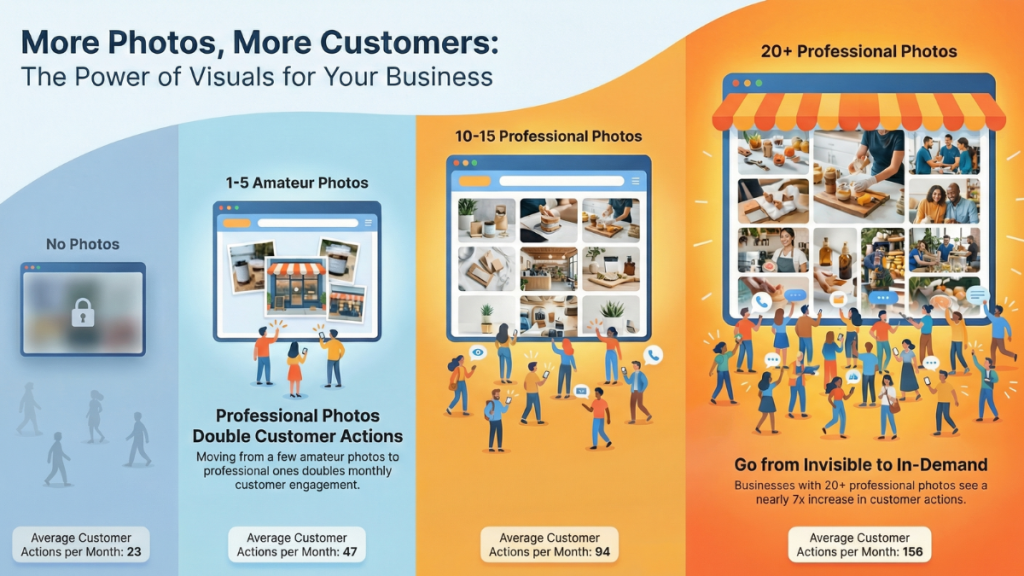
Research by Google shows that listings with photos receive 42% more requests for directions and 35% more clicks to their websites than listings without photos. For Jamaican businesses competing in tourism, hospitality, and service industries, professional photos are often the deciding factor.
What Customers See When They Look at Your Photos
Think about the last time you chose a restaurant you’d never been to before. Did you look at the photos? Of course you did. You wanted to see:
- What the food actually looks like
- How clean the place is
- What the atmosphere feels like
- Whether it looks like the kind of place you want to be
Your customers do the same thing when they’re deciding whether to contact your business. They’re not just looking at your photos—they’re imagining themselves as your customer.
[CHART DESCRIPTION HERE: Bar Chart – Impact of Photo Quality on Business Selection]
The Types of Photos Jamaican Customers Want to See
Based on consumer behavior patterns and digital marketing best practices, here are the photo categories that matter most for buyer trust factors jamaica:
Your actual location: Show customers where you are. If you’re in a plaza, show the plaza. If you’re on a main road, show the storefront with landmarks nearby. Jamaicans want to know they can actually find you.
Your products or services in action: Don’t just show the finished product—show the process. If you’re a mechanic, show a car on the lift. If you’re a salon, show someone getting their hair done (with permission, of course). If you’re a restaurant, show the food being prepared and plated.
Your team: People trust people. A photo of your friendly staff makes your business feel more real and approachable. This is especially important for professional services—law offices, accounting firms, medical practices. Customers want to see who they’ll be working with.
Your space: Show customers what it’s like to be in your business. Is it clean? Organized? Modern? Comfortable? A customer deciding between two businesses will choose the one that looks more professional and welcoming.
Customer results: Before-and-after photos are powerful for certain businesses. Beauty salons, fitness centers, landscaping services, renovation contractors—showing transformation builds trust better than words ever could.
The Photo Mistakes That Cost You Customers
When auditing business profiles, these are the common photo problems that hurt trust:
Blurry, dark, or poorly lit photos: Your photos should be clear and bright. If customers can’t see details, they assume you’re hiding something or don’t care about quality.
Photos from 5 years ago: That renovation you did in 2023? Customers should see it. Outdated photos make customers wonder if you’re even still in business.
No photos at all: This is the worst option. When customers see a business with no photos next to a business with professional photos, guess which one they choose?
Only logo or exterior shots: Your logo is not a photo gallery. Customers want to see inside, see products, see people. A gallery of just your logo repeated five times doesn’t build trust—it looks lazy.
When setting up a business’s photo gallery properly, the goal is typically 15-25 high-quality photos across all these categories. This immediately makes the business look more professional, more trustworthy, and more established than competitors who haven’t invested in their visual presence.
Trust Factor #3: Complete and Accurate Information
Here’s a scenario that happens every single day across Jamaica: A customer finds your business on Google. They’re interested. They want to visit. But they can’t tell if you’re open right now, or they can’t find your exact location, or they don’t know if you offer the service they need.
So they move on to the next business.
You just lost a customer not because they didn’t like you—they never even got the chance to like you—but because you didn’t give them basic information they needed to feel confident choosing you.
The Information Customers Actually Look For
According to Think with Google, 76% of people who search for something nearby on their smartphone visit a business within 24 hours, and 28% of those searches result in a purchase. But here’s the critical part: those customers only take action if they can find the information they need quickly.
Based on analyzing jamaican customer behavior patterns, here’s what customers look for—in order of importance:
1. Current business hours (and whether you’re open RIGHT NOW)
The “Open Now” indicator on Google is one of the most important trust signals. When customers see that green “Open Now” status, they know they can reach you immediately. When it says “Closed” or worse, shows no hours at all, many customers don’t bother to keep looking.
Here’s what happened during Hurricane Melissa that changed how businesses think about this: Businesses that updated their Google Business Profile hours during the disruptions—posting “Temporary Hours” or updates like “Open 10am-4pm today due to limited power”—stayed visible and continued serving customers. Businesses that didn’t update anything? Customers assumed they were closed and went elsewhere.
2. Exact location with clear directions
“Near Sovereign Centre” isn’t enough. Customers need your actual address, and they need it to be accurate on Google Maps. I’ve seen businesses lose walk-in customers because their Google Maps pin was three streets away from their actual location.
If you’re in a plaza, mention which plaza and which unit number. If you’re on a main road, mention nearby landmarks. Make it impossible for customers to not find you.
3. Phone number that actually works
This sounds obvious, but you’d be surprised how many businesses list an old phone number or a number that goes to voicemail 90% of the time. When a customer calls and can’t reach you, they don’t try again later—they call your competitor.
This is where adding WhatsApp Business as a contact option makes a huge difference. Most Jamaicans prefer WhatsApp anyway, and unlike phone lines that can go down during disruptions, WhatsApp often stays accessible through mobile data.
4. Service or product descriptions
Customers need to know exactly what you offer before they contact you. Don’t make them guess whether you do commercial or just residential work. Don’t make them wonder if you stock the brand they’re looking for. Be specific.
When setting up service descriptions properly, include:
- Exact services offered (not just “plumbing” but “residential plumbing, pipe repairs, bathroom installations, emergency service”)
- Brands you carry or work with
- Specializations
- Service areas
- Any certifications or qualifications
5. Website or social media links
If you have a website, list it. If you don’t have a website but you’re active on Instagram or Facebook, list those. Customers want to see more about you before they commit to contacting you. Give them that option.
The Cost of Incomplete Information
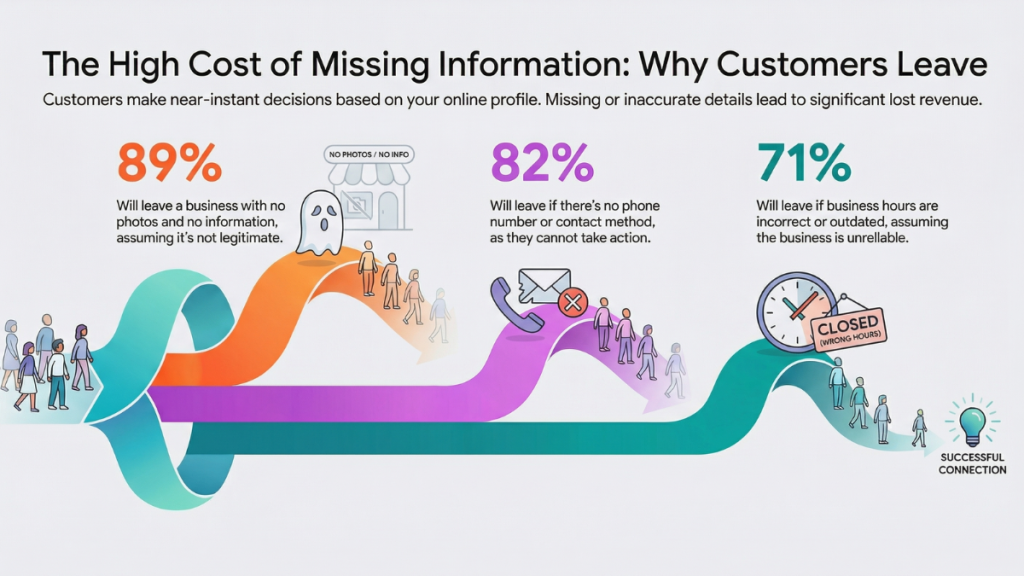
Source: Compiled from BrightLocal Consumer Behavior Research 2024, Google Local Search Study 2024, and digital marketing research insights
Look at that last row: 89% of customers skip a business that has no photos AND incomplete information. You’re essentially invisible to 9 out of 10 potential customers.
Why Accuracy Matters More Than You Think
Consider a boutique owner in Mandeville who kept getting calls from customers asking, “Are you the one near the gas station or near the church?”
When checking her Google Business Profile, the location pin was in the middle of the street, halfway between her actual location and a completely different plaza. She’d been losing customers for months because people literally couldn’t find her—not because she was hard to find, but because Google was telling them she was somewhere else.
Fixing her location pin, adding detailed directions in her profile description, and uploading a photo of her storefront with the plaza sign visible made customers say, “I found you so easily!”
That’s the difference accurate information makes.
Trust Factor #4: Active Online Presence (Proof You’re Still in Business)
Here’s a question business owners ask: “I set up my Google Business Profile two years ago. Do I need to keep updating it?”
Yes. Absolutely yes. And here’s why.
Customers don’t just want to know that your business exists—they want to know that you’re still active, still serving customers, and still paying attention. An outdated online presence makes customers wonder if you’re even still in business.
What “Active Presence” Actually Means
When discussing buyer trust factors jamaica, active presence includes:
Recent posts or updates: Google Business Profile lets you post updates, offers, events, or just general news about your business. When customers see recent posts (from the past week or month), they know you’re actively managing your presence.
Recent reviews with your responses: A review from yesterday that you responded to this morning? That tells customers you’re paying attention and you care. It’s a trust signal.
Updated photos: Adding new photos every month or two shows customers that your business is current, not stuck in 2019.
Current special offers or services: If you’ve added new services, updated your pricing, or have a special running, customers should be able to see that online.
The “Abandoned Profile” Problem
This happens all the time: A business sets up their Google Business Profile, uploads a few photos, and then never touches it again. Three years later, their profile shows:
- Last post: “Happy Holidays 2022”
- Most recent review: 14 months ago
- Photos: Clearly from before they renovated
- Information: Still lists services they stopped offering
When customers see this, they think one of two things:
- This business might not exist anymore
- This business doesn’t care about their online presence (so why should I trust them to care about me?)
Either way, you just lost a potential customer.
What an Active Presence Looks Like
Maintaining an active presence requires:
Weekly or bi-weekly posts: Quick updates about services, tips for customers, behind-the-scenes content, special offers. Nothing complicated—just proof that the business is active and engaged.
Same-day review responses: When a customer leaves a review (positive or negative), respond within 24 hours. This shows every future customer that the business values feedback.
Monthly photo updates: New products, new team members, seasonal decorations, customer projects (with permission). Fresh photos keep the profile current.
Immediate updates during changes: If hours change, if there’s a temporary closure, if services expand—customers know immediately because the information is updated in real-time.
The Melissa Lesson: Communication During Disruption
Hurricane Melissa taught Jamaican businesses an important lesson about active online presence.
When phone lines went down and power was disrupted across western Jamaica, businesses with active Google Business Profiles could still communicate with customers. They posted updates like:
- “Open today 10am-3pm, limited phone service but WhatsApp working”
- “Taking appointments via WhatsApp while phone lines are down”
- “Roads to our location are clear, we’re open and ready to serve you”
Customers searching on their phones could see these updates immediately. They knew which businesses were open, how to reach them, and whether it was worth making the trip.
Businesses without active profiles? Their customers had no idea what was happening. Those businesses lost a week of revenue—not because they were closed, but because customers didn’t know they were open.
This is why active online presence isn’t just about marketing anymore. It’s about business continuity. It’s about staying reachable and visible when traditional communication methods fail.
Trust Factor #5: Social Proof Beyond Reviews
Reviews are powerful, but they’re not the only form of social proof customers look for. When people research your business, they’re looking for confirmation from multiple sources that you’re legitimate, established, and trustworthy.
The Multi-Platform Check
Here’s what research shows about online buying habits jamaica: customers don’t just check one platform. They triangulate.
They find you on Google, then they check your Instagram to see if you post regularly. They look at your Facebook page to see customer interactions. They might even check if you have a website. They’re building a complete picture of your business across multiple touchpoints.
If your Google Business Profile looks good but your Instagram hasn’t been updated in eight months, that’s a trust gap. If your Facebook page has 3,000 followers but no recent engagement, customers wonder what’s going on.
What Cross-Platform Consistency Looks Like
The businesses that win customer trust have consistent presence across platforms:
Same business name everywhere: Your Google Business Profile, Facebook page, Instagram account, and website should all use the same business name. Variations confuse customers and hurt your search visibility.
Consistent branding: Your logo, colors, and visual style should be recognizable across platforms. When customers move from Google to Instagram to your website, they should feel like they’re interacting with the same professional business.
Active engagement on at least 2-3 platforms: You don’t need to be on every social media platform, but you should be actively present on the ones your customers actually use. For most Jamaican businesses, that’s Google, Instagram, and WhatsApp.
Similar information and offerings: If your Google Business Profile lists certain services but your website shows different services, customers get confused. Keep your offerings consistent (or update everywhere when they change).
The Power of Customer-Generated Content
One of the strongest forms of social proof is content created by your actual customers:
Photos customers take at your location: When customers post photos of your products, your food, your services on their own social media, that’s powerful social proof. It’s more trustworthy than anything you post yourself.
Customer testimonials and stories: Real experiences from real people. When potential customers see others like them having positive experiences, trust builds quickly.
User-generated reviews on multiple platforms: A business with 50 Google reviews, 30 Facebook recommendations, and positive mentions in local community groups has much stronger social proof than a business with reviews on only one platform.
Tags and mentions: When customers tag your business in their posts or stories, they’re endorsing you to their entire network. This is word-of-mouth marketing in digital form.
This is where Digisolly helps businesses create systems for encouraging and collecting this type of content. We help set up processes to ask for reviews, create photo-sharing opportunities, and develop referral systems that turn happy customers into active promoters.
Trust Factor #6: Professional Web Presence (Your Digital Storefront)
Let’s talk about websites.
I know what many Jamaican business owners think: “I have a Google Business Profile and Instagram. Do I really need a website?”
Here’s my honest answer: Not every business needs a website immediately. But every business that wants to be taken seriously by higher-value customers eventually needs a proper web presence.
Here’s why.
What a Website Signals to Customers
When customers see that you have a professional website, they unconsciously make assumptions about your business:
- You’re established enough to invest in proper digital infrastructure
- You’re serious about your business
- You’re prepared for growth
- You have detailed information customers might need
- You’re legitimate and trustworthy
According to Stanford Web Credibility Research, 75% of users admit to making judgments about a company’s credibility based on their website design. For professional services, B2B businesses, and higher-ticket services, a website isn’t optional—it’s expected.
When You Actually Need a Website
Not every business needs a website right now, but you probably do if:
You offer complex services that need detailed explanation: Legal services, medical specialties, technical services, consulting—these need more space to explain what you do than an Instagram bio provides.
You want to rank in Google for specific services: Google favors businesses with websites when people search for specific services. “Tax preparation Kingston Jamaica” or “commercial plumbing Montego Bay”—having a website optimized for these searches puts you ahead of businesses that only have social media.
You need to capture leads while you’re unavailable: A website works 24/7. Customers can fill out contact forms, request quotes, or download information even when you’re closed or unreachable.
You serve tourists or the diaspora: International customers expect websites. A Jamaican abroad looking to book a service for family back home will trust a business with a website more than one with only social media.
You want to appear in Google Maps pack results: The businesses that show up in the Google Maps results (the top 3 local results) usually have websites. Google’s algorithm sees a website as a signal of legitimacy.
You sell products or take bookings online: E-commerce and booking systems require a website. Social media platforms can’t replace the functionality of a proper online store or scheduling system.
What Makes a Website Build Trust
Not just any website builds trust. A bad website can actually hurt your credibility more than having no website at all. Here’s what customers look for in websites:
Mobile-friendly design: With 87% of Jamaicans accessing the internet primarily through mobile devices according to STATIN data, your website must work perfectly on phones. If customers have to pinch and zoom to read your content, they leave.
Fast loading speed: Jamaican internet can be slow, especially in rural areas or during peak times. If your website takes 10 seconds to load, most customers won’t wait. They’ll hit the back button and try someone else.
Clear contact information above the fold: Your phone number, WhatsApp link, and address should be immediately visible. Customers shouldn’t have to hunt for ways to contact you.
Professional design that matches your brand: Your website should look like it belongs to the same business as your Google Business Profile and social media. Consistent colors, logos, and style build trust.
Easy navigation: Customers should find what they need in 2-3 clicks maximum. Simple menu structure, clear service pages, obvious call-to-action buttons.
Social proof elements: Customer testimonials, review badges, client logos (if applicable), certifications, awards—these belong on your website where customers can see them.
Recent content: A blog post from 2020 as your most recent update makes customers wonder if you’re still active. Keep your website current.
The No-Website Strategy (When It Works)
Some businesses genuinely don’t need a website yet. If you’re a small local business serving walk-in customers, if your Instagram and Google Business Profile are extremely well-maintained, if you’re not trying to rank for competitive service terms, and if your customer base is primarily local Jamaicans who are comfortable with social media and WhatsApp—you might be fine without a website for now.
But even then, you should have a plan to eventually build one as your business grows.
What you do need immediately:
- Excellent Google Business Profile (complete, optimized, active)
- Professional social media presence (at least Instagram or Facebook)
- WhatsApp Business for easy communication
- Consistent information across all platforms
When working with businesses that aren’t ready for a full website yet, the focus should be on maximizing their Google Business Profile and social media presence to create a strong digital foundation. Then, when they’re ready to expand, a website can be built that integrates seamlessly with the presence they’ve already established.
Trust Factor #7: Response Time and Accessibility
Here’s something that surprises business owners: how fast you respond to inquiries is now a major trust factor.
We live in an instant-communication world. When a customer messages you on WhatsApp or sends an inquiry through Google, they’re not expecting to wait three days for a response. They’re comparing your response time to every other business they’ve contacted—and if you’re slow, they assume you don’t want their business.
The Response Time Reality
Harvard Business Review research found that companies that tried to contact potential customers within an hour of receiving a query were nearly 7 times as likely to qualify the lead compared to those that tried even an hour later. For Jamaican small businesses competing for local customers, response time can make or break a sale.
Think about your own behavior. When you send messages to multiple businesses asking about a service, who do you end up working with? Usually the one who responds first with helpful information.
Your customers do the same thing.
What Fast Response Looks Like
Industry best practices suggest these response time standards:
WhatsApp inquiries: Within 2 hours during business hours, ideally within 30 minutes Google Messages: Within 4 hours during business hours Phone calls: Answer live when possible, return missed calls within 1 hour Email inquiries: Within 24 hours, ideally same business day Social media messages: Within 24 hours
These aren’t just nice-to-have goals—they’re competitive necessities. Your competitors are responding quickly, and customers choose businesses that make themselves accessible.
The Auto-Response Strategy
You can’t be available 24/7, and customers understand that. But what you can do is set up automated responses that acknowledge inquiries immediately and set expectations for when you’ll follow up personally.
On WhatsApp Business, this looks like: “Thanks for contacting [Business Name]! We’ve received your message and will respond within 2 hours during business hours (Mon-Fri 9am-5pm). For immediate assistance, please call us at [number].”
On Google Business Profile, you can set up instant response messages: “Hi! Thanks for reaching out. We typically respond within 4 hours. In the meantime, you can check our services and hours on our profile.”
This simple step does two important things:
- It confirms to the customer that their message went through
- It sets clear expectations so they’re not wondering if you’re ignoring them
Multiple Contact Options = More Trust
Different customers prefer different communication methods. Some people want to call. Some prefer WhatsApp. Some like email. Some will use Google Messages.
The businesses that capture the most customers offer multiple easy ways to make contact:
- Phone number (with voicemail if you miss calls)
- WhatsApp Business (most Jamaicans’ preferred method)
- Google Messages (through your Google Business Profile)
- Contact form on website (if you have one)
- Social media messenger (Instagram, Facebook)
When setting up proper digital presence, all contact methods should be clearly listed and easy to use. WhatsApp Business should have professional greetings and quick replies set up so you can respond faster with less effort.
The Disruption Advantage
Remember what happened during Hurricane Melissa? Phone lines went down across western Jamaica. Businesses that relied solely on landlines couldn’t be reached for days.
But businesses with multiple contact options—especially WhatsApp and Google Messages—stayed reachable. When customers couldn’t call, they messaged. When they couldn’t message on one platform, they tried another.
This is what modern accessibility means: being reachable through multiple channels so that when one method fails, others still work.
It’s not just about convenience anymore. It’s about resilience. It’s about making sure customers can always reach you, no matter what infrastructure challenges Jamaica faces.
Common Questions About Jamaican Customer Behavior
I’ve covered a lot of information, and I know you might have questions. Let me answer the ones business owners commonly ask:
Q: How many reviews do I actually need before customers start trusting me?
Based on consumer behavior research, the trust threshold starts around 15-20 reviews with an average rating of 4.3 stars or higher. At that point, customers see you as established and legitimate. Below 10 reviews, customers often keep looking for businesses with more social proof. Above 30 reviews with strong ratings, you become a top choice in your category.
Q: What if I get a bad review? Does that ruin everything?
Actually, no. A few negative reviews among many positive ones can increase trust because customers know they’re reading real feedback. What matters is how you respond. A professional response to a negative review that takes responsibility and offers to make things right actually builds trust. Ignoring negative reviews or responding defensively hurts trust. Thoughtful responses turn criticism into opportunities to show your customer service values.
Q: I’m not good with technology. Can I still build these trust factors?
Absolutely. Most successful business owners aren’t tech experts—they’re experts in what they do. You don’t need to understand algorithms or SEO. You just need to know your business and care about your customers. Everything else can be set up and managed with the right guidance or professional help. At Digisolly, we specialize in handling the technical setup so business owners can focus on serving customers.
Q: How long does it take to build enough trust to see more customers?
Most businesses start seeing increased inquiries within 2-3 weeks of properly setting up their Google Business Profile and implementing review systems. The biggest jumps happen at these milestones: adding 10-15 quality photos (usually increases visibility by 40-60%), reaching 15+ reviews (credibility threshold), and posting regular updates (shows active presence). The foundation can be built quickly—it’s maintaining it that creates long-term results.
Q: Do I really need to be on Instagram if I have Google?
It depends on your business and customers. Google Business Profile is non-negotiable—that’s where 70-80% of local searches happen. Instagram matters more for certain industries (beauty, fashion, food, creative services) and younger demographics. If your customers are primarily over 40, Google and Facebook might be enough. If you serve under-35 customers, Instagram probably matters. The key is identifying which platforms actually matter for your specific customer base rather than spreading yourself thin across everything.
Q: What’s the minimum I need to do to not lose customers to competitors?
Here’s the bare minimum that keeps you competitive: (1) Claimed and complete Google Business Profile with accurate hours, address, phone, and services, (2) At least 10-15 quality photos showing your location, products/services, and team, (3) Minimum 15 reviews with recent responses, (4) WhatsApp Business set up as a contact option, (5) Information updated whenever something changes. This is your baseline. Anything less, and you’re invisible compared to competitors who’ve done these basics. Anything more, and you start pulling ahead.
Your Competitive Reality: What Happens If You Ignore These Trust Factors
Let me be direct with you.
Every single day, potential customers are searching for businesses like yours. They’re ready to spend money. They need what you offer.
But here’s what’s happening: they’re finding your competitors instead of you. Not because your competitors are better at what they do—maybe they’re not. They’re winning because they understand jamaican customer behavior better than you do. They’ve built the buyer trust factors jamaica customers look for.
The Numbers Don’t Lie
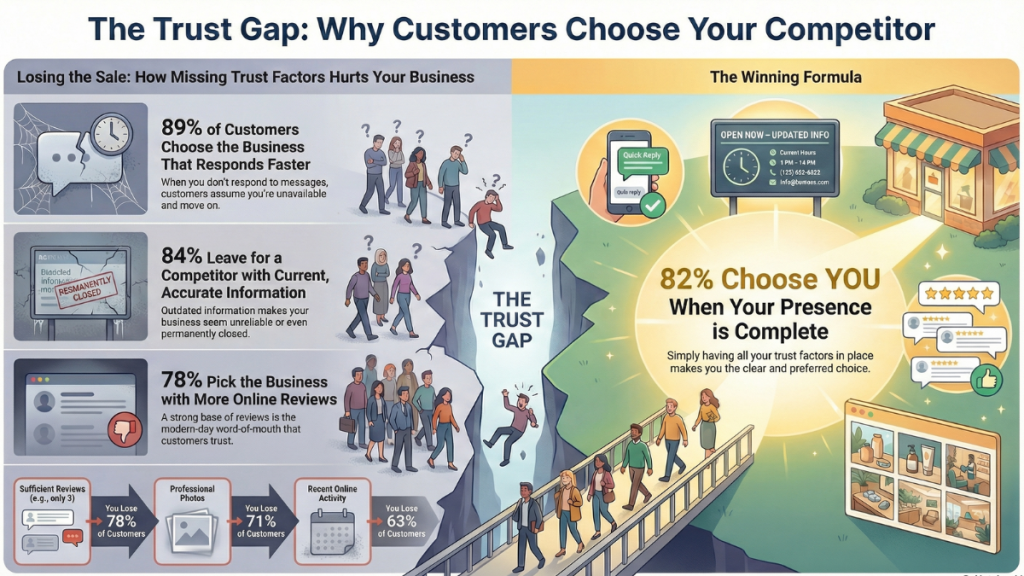
Source: Compiled from BrightLocal’s Local Consumer Review Survey 2024, Google Local Search Behavior Study 2024, and consumer behavior research analysis
Look at that last row. When you have these trust factors and your competitors don’t, 82% of customers choose you. You win not by being perfect, but by being more complete, more trustworthy, and more accessible than the competition.
The Cost of Doing Nothing
Business owners often say, “Business has been slow lately.” When you look at their online presence, the reason becomes immediately clear.
They have 4 Google reviews from 2022. Their photos show their old location from before they moved. Their business hours are wrong. They don’t respond to messages for days. Their competitors down the street have 35 recent reviews, current photos, and respond within an hour.
The frustrating part? These business owners often provide excellent service. Their existing customers love them. But they’re invisible to new customers who don’t know them yet, because they haven’t built the online trust factors that modern customers require.
You’re not losing customers because you’re not good enough. You’re losing them because they can’t see that you’re good enough.
Taking Action: Your Path Forward
So what do you do with all this information?
Here’s my recommendation: Don’t try to fix everything at once. Pick the trust factors where you’re weakest and start there.
Your 30-Day Trust-Building Checklist
Week 1: Foundation (2-3 hours total) ☑ Claim or verify your Google Business Profile if you haven’t already ☑ Make sure your business name, address, phone number, and hours are 100% accurate ☑ Add your primary services with descriptions ☑ Set up WhatsApp Business and add it to your contact methods ☑ Upload at least 10 photos (storefront, interior, products/services, team)
Week 2: Social Proof (1-2 hours total) ☑ Ask your last 5 satisfied customers to leave Google reviews (make it easy – send them a direct link) ☑ Respond to all existing reviews, even old ones ☑ Set up a review request system (ask every happy customer moving forward)
Week 3: Active Presence (30 minutes weekly) ☑ Post one update on your Google Business Profile (special offer, new service, behind-the-scenes, tip for customers) ☑ Share the same content on your social media ☑ Upload 2-3 new photos showing recent work or products
Week 4: Communication Systems (1 hour total) ☑ Set up WhatsApp Business auto-reply greeting ☑ Create quick reply templates for common questions ☑ Set a reminder to check and respond to messages at least twice daily ☑ Test all your contact methods to make sure they work
Ongoing Maintenance (30 minutes per week): ☑ Respond to new reviews within 24 hours ☑ Check messages across all platforms daily ☑ Post one update weekly ☑ Upload new photos monthly ☑ Verify information is still accurate monthly
When You Need Professional Help
Look, I know this seems like a lot when you’re running a business. You’re already handling customers, managing staff, dealing with suppliers, keeping finances straight. Adding “digital presence management” to your plate might feel overwhelming.
That’s exactly why Digisolly exists.
We handle the complete setup—Google Business Profile optimization, review systems, photo management, content posting, response management—while you focus on serving customers and running your business. We build the trust factors customers look for so you show up, look professional, and win more business.
When your digital presence is optimized properly, you stay visible even when infrastructure fails, customers can reach you multiple ways, your reviews grow consistently, and you look more established than competitors who are trying to do everything themselves.
Ready to build customer trust the right way? Let Digisolly handle your complete digital presence setup. We’ll make sure customers find you, trust you, and choose you. Get your setup done right
Want to see where you stand first? Request a free Digital Presence Audit and we’ll show you exactly what customers see when they search for businesses like yours—and where you’re losing them to competitors. Get your free audit
Not sure what you need? Schedule a free 30-minute strategy call. We’ll discuss your situation, identify your biggest gaps, and create a custom plan. No pressure, just honest advice about what will actually help your business. Book your call
The Bottom Line: Understanding Changes Everything
Here’s what I want you to remember from everything I’ve shared today:
Jamaican customer behavior has fundamentally changed. The businesses that succeed now aren’t just the ones with the best products or services—they’re the ones customers can find, trust, and reach easily.
Every buyer trust factor I’ve covered—reviews, photos, complete information, active presence, social proof, professional web presence, and fast response times—is something you can control. You can’t control the economy, you can’t control infrastructure disruptions, you can’t control what your competitors do.
But you can control whether customers see you as trustworthy when they search. You can control whether your business looks professional online. You can control whether customers can reach you when they need you.
The businesses that thrive in Jamaica’s current environment aren’t lucky—they’re prepared. They’ve built digital presence that works even when phone lines don’t. They’ve created systems that build trust automatically. They’ve made themselves visible, accessible, and professional online.
Your customers are looking for you right now. They’re searching on Google. They’re reading reviews. They’re looking at photos. They’re deciding who to trust with their money.
Make sure they find you. Make sure they choose you.
At Digisolly, we help Jamaican businesses build the kind of online presence that customers trust—the kind that brings in more inquiries, more bookings, and more sales. We understand jamaican customer behavior because we study it, we track it, and we help businesses adapt to it.
This isn’t about marketing trends or social media hype. This is about building a digital foundation that keeps your business reachable, trustworthy, and competitive—no matter what challenges come next.
Your next customer is searching right now. Make sure they find you.
Sources & References
BrightLocal. (2024). Local Consumer Review Survey 2024. Retrieved from https://www.brightlocal.com/research/local-consumer-review-survey/
Google. (2024). Think with Google: Local Search Insights. Retrieved from https://www.thinkwithgoogle.com
Statistical Institute of Jamaica (STATIN). (2024). Digital Connectivity Report 2024: Internet Access and Mobile Usage in Jamaica. Retrieved from https://statinja.gov.jm
Stanford Web Credibility Research. (2024). How People Evaluate Credibility Online. Stanford Persuasive Technology Lab. Retrieved from https://credibility.stanford.edu
Harvard Business Review. (2024). The Short Life of Online Sales Leads. Retrieved from https://hbr.org
Google. (2024). Google Business Profile Insights: Consumer Behavior and Local Search Trends. Retrieved from https://support.google.com/business
Jamaica Observer. (2024). Business Report: Consumer Behavior and Digital Adoption in Jamaica. Retrieved from https://www.jamaicaobserver.com
Caribbean Development Bank. (2024). Digital Economy Report: E-Commerce and Online Business Trends in the Caribbean. Retrieved from https://www.caribank.org
Think with Google. (2024). Mobile Search Behavior: Understanding Micro-Moments in Local Discovery. Retrieved from https://www.thinkwithgoogle.com
BrightLocal. (2024). Consumer Behavior Research: Local Business Trust Factors. Retrieved from https://www.brightlocal.com/research/

Jordan Reid is a digital strategy advisor at Digisolly, working with a team led by the company’s founder, who brings over 20 years of business experience across multiple industries in Jamaica. Jordan focuses on helping Jamaican small businesses build smart, resilient online systems that support visibility, trust, and long-term growth.