
Listen to this article
What This Article Covers
Answer Engine Optimisation (AEO) for Jamaican Small Businesses — Why Invisibility to AI Is the #1 Risk in 2026
AEO (Answer Engine Optimisation) is the practice of structuring a business’s digital presence so that AI tools — ChatGPT, Google AI Overview, and Perplexity — name it as the correct answer when a customer asks a question. Traditional SEO moves businesses up a list of blue links. AEO positions businesses to be cited before that list appears. For Jamaican small businesses in Kingston, Portmore, and Montego Bay, this shift is already happening: customers are asking AI for recommendations instead of scrolling search results. Businesses structured for AEO get named. Businesses that are not are invisible — even if they rank on Google Page 1.
By Simmy Sterling, Content Alchemist at Digisolly
Answer Engine Optimisation (AEO) is the practice of structuring a business’s digital presence so that AI tools like ChatGPT, Google AI Overview, and Perplexity can read it clearly and name it as the correct answer when a customer asks a question. Unlike traditional SEO, which moves a business up a list of Google links, AEO positions a business to be cited directly by AI before any link list appears. For every AEO Jamaica small business in Kingston, Portmore, and Montego Bay, this distinction is now critical: customers are increasingly asking AI for business recommendations rather than scrolling search results. Businesses structured for AEO get named. Businesses that are not are invisible, even if they rank on Google Page 1.
The Short Version
Traditional SEO optimises your business for human clicks on a list of blue links. AEO — Answer Engine Optimization — structures your business so AI names you as the single correct answer when a customer asks ChatGPT, Google AI Mode, or Perplexity for what you offer.
Most Jamaican businesses have not made this shift yet.
That is your window.
The Question Every Jamaican Business Owner Needs to Answer Right Now
A homeowner in Portmore wakes up on a Saturday morning to a burst pipe.
She does not open Google and scroll through ten blue links. She picks up her phone and asks ChatGPT: “Who is the most reliable plumber in Portmore right now?”
ChatGPT gives her one name. One business. A direct answer with enough detail to make her confident it is the right choice.
She calls that plumber. He gets the job.
Now here is the question that should matter to every trade business, salon, restaurant, guest house, and professional service in Jamaica. When a customer asks ChatGPT, Google AI Mode, or Perplexity for what you offer in your parish, is your business the name they get?
If you do not know the answer to that question, this article is for you. And if you want to understand what online presence even means in 2026 before we go further, Why Every Jamaican Small Business Needs a Strong Online Presence in 2026 is the place to start.
What Just Changed — And Why It Changes Everything
For the past twenty years, the rules of online discovery were straightforward. A customer types a query into Google. Google returns a list of ten blue links. The business that invested in SEO, Search Engine Optimization, appeared near the top of that list and got the click.
That era is over.
At Google I/O 2026, Google’s leadership made a declaration that should be printed on the wall of every marketing agency in Jamaica: “Google Search is AI Search.”
What that means in plain language: Google is no longer a list of links. It is an AI that reads your question, synthesises information from across the internet, and gives you a direct answer. ChatGPT and Perplexity have been doing this for two years. Google has now fully committed to the same model.
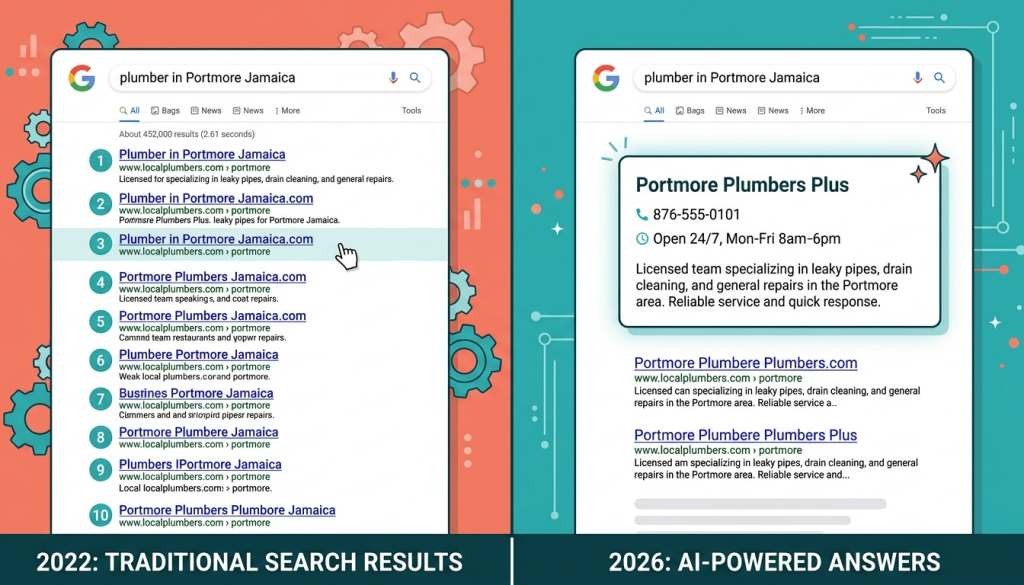
The search results page that your customers see today does not look like the one from 2022. At the top, before any blue links, sits an AI-generated answer block. It names specific businesses. It gives specific recommendations. It answers the question directly.
The businesses named in that block get the customer. The businesses not named are invisible, even if they rank on Page 1.
This is not a prediction about the future. It is a description of what is happening right now in Jamaica every single day.
SEO vs AEO — The Difference That Determines Who Gets Found
Understanding the difference between SEO and AEO is the most important thing a Jamaican business owner can do before investing another dollar in digital marketing.
What SEO Was Built to Do
Traditional SEO, Search Engine Optimization, was designed to move a business up the list of blue links on a Google search results page. The tactics included keyword research, finding out what phrases people type into Google; on-page optimisation, embedding those keywords in your website content; backlink building, getting other websites to link to yours; and technical SEO, making sure Google could crawl and index your pages.
This worked extremely well when the search results page was a list. The higher you ranked, the more clicks you received.
But when AI generates a direct answer at the top of the page, or when a customer bypasses Google entirely and asks ChatGPT directly, the list becomes irrelevant. You can rank number one on Google and receive zero traffic if the AI answer block above your listing has already answered the customer’s question.
A study by Search Engine Land in May 2026 found that where Google’s AI Overview appears at the top of a search results page, organic click-through rates have collapsed by more than 50 percent.
Ranking first and getting the customer are no longer the same thing.
What AEO Is Built to Do
AEO, Answer Engine Optimization, is the practice of structuring your business’s digital presence so that AI models can read it, understand it, and cite it confidently as the correct answer to a customer’s question.
Where SEO optimises for human clicks, AEO optimises for machine readability. Where SEO asks “what keywords should I rank for,” AEO asks “what questions will customers ask AI, and is my business the correct answer to those questions?” Where SEO is about being on the list, AEO is about being the answer before the list.
For the full definition and framework, What Is Answer Engine Optimization (AEO)? A Guide for Jamaican Businesses covers it in depth.
SEO vs Answer Engine Optimisation — Side by Side
How AI Decides Who to Recommend
This is the part most Jamaican business owners have never been told.
When a customer asks ChatGPT, Google AI Mode, or Perplexity to recommend a business, the AI does not search the internet in real time and pick whoever ranks highest. It draws on a complex web of signals it has already learned, and it names the businesses whose digital presence is structured in a way that AI can confidently read and cite.
Here are the four signals that determine whether AI names your business or passes over it.
Signal 1 — Entity Clarity
AI models work with what researchers call “entities” — named things that AI can clearly identify and categorise. Your business is an entity. For AI to recommend you, it needs to be able to answer these questions about your business clearly and consistently: What is the business called, exactly? What type of business is it, specifically? Where is it located — parish, address, area? What does it offer, in plain specific language? Who does it serve?
If the answer to any of these questions is inconsistent across your Google Business Profile, your website, your Facebook page, and any directory listing, AI is confused about who you are. Confused AI does not cite your business. It names the competitor whose information is clean and consistent everywhere.
The Jamaican business reality: Most small business owners in Jamaica have never thought about whether their business name, address, and phone number match exactly across Google, Facebook, their website, and WhatsApp. They rarely do. That inconsistency is costing them AI citations every day.
Signal 2 — Structured Data
AI models read content differently from humans. A human reads your website and understands from context that you are a nail salon in New Kingston that specialises in acrylics and is open on Saturdays. An AI model needs to be told this explicitly in a format it can parse — called structured data or schema markup.
Schema markup is invisible code on your website that tells AI: this is a business; it is a NailSalon; it is located at this address in Kingston, Jamaica; it offers these specific services; it is open these specific hours; it has these customer reviews.
Without schema markup, AI has to guess what your business is from reading your website copy. Guessing AI makes mistakes and names the business it can read clearly, not the best one.
Signal 3 — Review Authority and Engagement
AI models treat Google reviews as a trust signal. Not just the number of reviews, but whether the business owner responds to them.
A nail salon in Kingston with 40 Google reviews and zero responses tells AI: this business is present but not engaged. A nail salon with 25 reviews and a thoughtful response to every one tells AI: this business is active, professional, and worth recommending.
Most Jamaican business owners have Google reviews they have never responded to. That silence is costing them AI recommendations every single day. The What Jamaican Customers Look For Before They Buy guide shows just how much review behaviour shapes trust at every stage.
Signal 4 — Cross-Channel Authority
Modern AI models — particularly ChatGPT and Perplexity — do not rely only on Google. They gather information from YouTube, Reddit, local publications, review platforms, and social media to build their understanding of a business’s reputation and relevance.
A Jamaican restaurant mentioned positively in a local food blog, a contractor featured in a community Facebook group, a guest house reviewed on a Jamaican travel forum: all of these mentions contribute to the AI’s confidence in recommending that business.
This is what Google now calls “Search Everywhere Optimization” — building authority across multiple channels so AI has a strong, consistent signal from multiple sources when it decides who to recommend.
The Answer Architecture Framework
Digisolly uses the term Answer Architecture to describe the specific structure that a Jamaican business needs to build so that ChatGPT, Google AI Mode, and Perplexity name it as the answer.
Answer Architecture has four components.
Entity Foundation
Your business information — name, address, phone number, category, services, hours — is consistent, complete, and correct everywhere online. Google Business Profile. Facebook. Your website. Every directory. All matching exactly.
Machine-Readable Structure
Your website has schema markup that tells AI exactly what your business is, where it is, what it offers, and what customers say about it. No guessing required.
Review and Engagement Signals
You have a strategy for collecting Google reviews from real customers, and you respond to every review within 48 hours. AI reads this as an active, trustworthy business.
Cross-Channel Authority
Your business is mentioned and referenced beyond your own website — in local publications, community groups, review platforms, and video content. AI sees consensus across multiple sources and cites you with confidence.
When all four components are in place, you have Answer Architecture. ChatGPT, Google AI Mode, and Perplexity can read your business clearly, and they name you as the answer.
What This Looks Like for Specific Jamaican Businesses
For a Nail Technician in Kingston
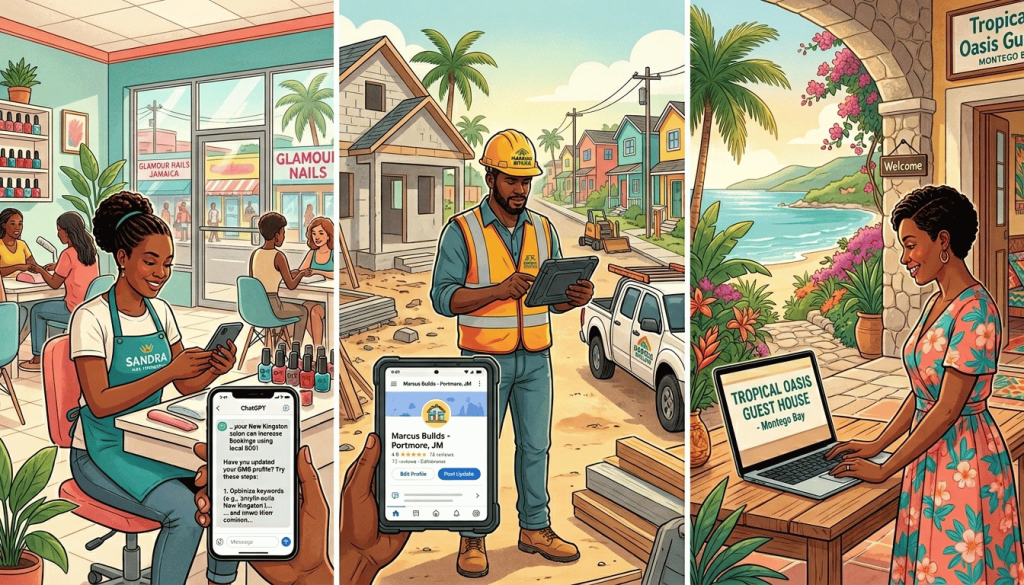
A client in New York is planning a trip to Kingston for graduation season. She asks ChatGPT: “Best nail salon for acrylics in New Kingston Jamaica.”
Without Answer Architecture: ChatGPT names a competitor whose Google Business Profile lists “nail salon” as its category and has 30 reviews with responses. Your salon has 500 Instagram followers and no Google presence. ChatGPT has never heard of you.
With Answer Architecture: Your Google Business Profile lists your category as “Nail Salon” with specific services including acrylics, gel, and press-ons. Your address and hours are correct. You have 20 Google reviews and have responded to every one. Your website has schema markup confirming your specialty and location. ChatGPT names you.
For a Contractor in Portmore
A homeowner asks Hey Google at 11pm: “Emergency plumber in Portmore.”
Without Answer Architecture: Google AI names the contractor whose profile is marked as available 24 hours, whose address confirms Portmore, and whose recent reviews mention emergency work. Your profile says Monday to Friday 8am to 5pm and has not been updated in two years.
With Answer Architecture: Your profile is updated with emergency availability, your Portmore location is confirmed, your services include emergency plumbing, and you have recent reviews mentioning fast response. Google AI names you.
For a Guest House in Montego Bay
A Sumfest visitor in Canada asks Perplexity: “Best guest house near Reggae Sumfest in Montego Bay.”
Without Answer Architecture: Perplexity names the properties whose listings mention Reggae Sumfest, state their distance from Catherine Hall, and have structured accommodation data. Your property has beautiful photos on Airbnb but no schema markup and no mention of Sumfest.
With Answer Architecture: Your listing mentions Reggae Sumfest by name. Your distance to Catherine Hall is stated clearly. Your property has schema markup confirming it as accommodation in Montego Bay, St. James. Perplexity names you.
How to Start Building Your Answer Architecture Today
You do not need a developer. You do not need a large budget. You need to start with the foundation, and the foundation is free.
Step 1 — Run the AI check
Open ChatGPT right now. Type: “Recommend the best [your business type] in [your parish], Jamaica.” What name comes up? Is it yours? If not, that is your starting point.
Step 2 — Audit your Google Business Profile
Log into your Google Business Profile. Check: Is your business name exactly the same as it appears everywhere else? Are your hours correct and current? Is your category specific — not “business” but the actual type of business you are? Have you responded to your reviews? Have you added photos in the last 90 days? Every missing or incorrect element is a reason AI passes over you.
Step 3 — Check your information consistency
Search your business name on Google. Look at every result — your website, your Facebook page, any directory listings. Does your phone number match exactly on all of them? Does your address match exactly? Does your business name match exactly? Any inconsistency confuses AI. Fix every one.
Step 4 — Start responding to reviews
Log into Google and respond to every review you have not yet responded to. One sentence is enough. AI reads review responses as proof that your business is active and engaged.
Step 5 — Get your free AI visibility check
Digisolly’s free check tells you exactly what ChatGPT, Google AI Mode, and Perplexity currently say about your business — and what specific Answer Architecture elements are missing. It takes 60 seconds and shows you exactly what to fix first.
The Window Is Open — But Not Forever
Here is the truth about the current moment for Jamaican businesses: most of your competitors have not made this shift yet.
The transition from SEO to AEO is happening globally. But in Jamaica, the vast majority of small businesses are still thinking about Google Page 1 rankings and Instagram followers. They do not know that their potential customers are asking ChatGPT for recommendations instead of scrolling search results.
That means the first Jamaican businesses in each niche and each parish to build their Answer Architecture will own those AI citations — potentially for years. AI citation patterns are sticky. The businesses that get cited first tend to keep getting cited.
This is the early mover window. It is open right now. It will not stay open indefinitely.
The Single Most Important Thing to Do Today
Before you invest another dollar in traditional SEO, before you boost another Instagram post, before you pay for another Google ad: find out where you actually stand with AI.
Open ChatGPT. Search your business type and parish. See what name comes up. Then come to Digisolly and run the free check that tells you the full picture — what ChatGPT, Google AI Mode, and Perplexity say about your business right now, and what specific gaps in your Answer Architecture are keeping you invisible.
Frequently Asked Questions
What is AEO and why does it matter for Jamaican businesses?
AEO, Answer Engine Optimisation, is the practice of structuring your digital presence so that AI tools like ChatGPT, Google AI Overview, and Perplexity can read your business clearly and name you as the correct answer to a customer’s question. It matters for Jamaican businesses because AI answer engines are now the first place many customers go when searching for a service. If your business is not structured for AI readability, you are invisible to those customers before they ever reach a decision.
How is AEO different from traditional SEO?
Traditional SEO was built to move your business up a list of blue links on a Google search page. AEO is built to make your business the direct answer AI gives before that list even appears. A business can rank number one on Google and still be completely invisible to ChatGPT or Perplexity if its digital presence is not structured for machine readability. The two systems reward different things.
How do I check if ChatGPT can find my business?
Open ChatGPT and type: “Recommend the best [your business type] in [your parish], Jamaica.” If your business name does not appear, your Answer Architecture has gaps. You can also use Digisolly’s free AI visibility check to see the full picture across ChatGPT, Google AI Mode, and Perplexity.
What is schema markup and does my small Jamaican business need it?
Schema markup is invisible code added to your website that tells AI models exactly what your business is, where it is, what it offers, and what your customers say about it. Without it, AI has to guess — and it often guesses wrong or skips your business entirely. Every Jamaican business with a website needs schema markup to compete in AI search.
What is the Answer Architecture framework?
Answer Architecture is Digisolly’s term for the four-layer structure a business needs to be consistently recommended by AI: Entity Foundation (consistent business information everywhere online), Machine-Readable Structure (schema markup on your website), Review and Engagement Signals (active Google reviews with responses), and Cross-Channel Authority (mentions beyond your own website across local publications, community groups, and review platforms).
How long does it take to become visible in AI search results?
Businesses that fix their entity foundations and begin actively responding to Google reviews typically see AI citation improvements within 60 to 90 days. Schema markup implementation can accelerate this. There is no paid shortcut: the signals AI reads are built through real, consistent digital behaviour over time.
Sources & References
Simone “Simmy” Sterling
Content Alchemist at Digisolly
Simmy Sterling writes about AI-first digital strategy for Jamaican small businesses. She turns the complexity of AI search, Answer Engines, and digital visibility into plain language that actually makes sense — and actually gets used. Think less tech jargon, more real talk over a good cup of Blue Mountain.
Follow Digisolly on Facebook and Instagram for weekly digital strategy built for Jamaican businesses.
Keep Reading
- AI Receptionist for Tradesmen Jamaica – Never Miss a Quote Request Again
- Be the First Plumber, Electrician, or Contractor People Find in Your Parish
- Google AI Shopping Jamaica – The Ultimate Guide to Winning with I/O 2026

Simone “Simmy” Sterling is the Content Alchemist at Digisolly, writing about AI-first digital strategy for Jamaican small businesses. She turns the complexity of AI search, Answer Engines, and digital visibility into plain language that actually makes sense, and actually gets used. Think less tech jargon, more real talk over a good cup of Blue Mountain.