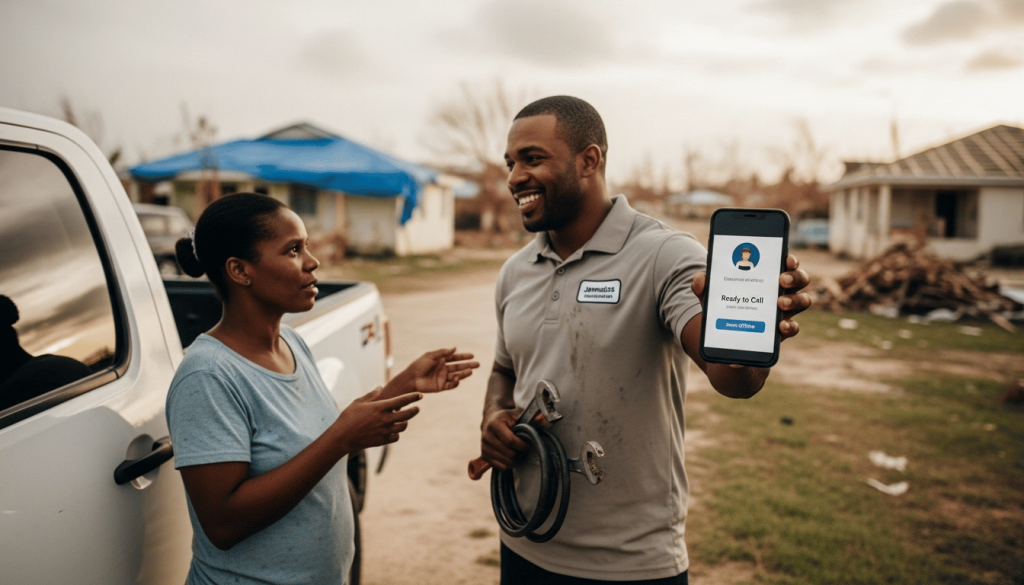
A Jamaican contractor stays visible and reachable during grid failures and power outages by combining three independent communication channels: an offline-capable website that serves cached content on slow or intermittent connections, an active WhatsApp Business account that receives messages asynchronously, and an up-to-date Google Business Profile that shows hours, location, and status even when your phone line is down. The contractors who kept winning jobs during Jamaica’s infrastructure disruptions were not necessarily the best-equipped — they were the ones customers could still find and contact when normal channels failed. Treating your digital presence as communication infrastructure, not just advertising, is the practical difference between going dark and staying reachable when conditions are at their worst.
Listen to this article
Picture this. A homeowner in Mandeville wakes up on a Wednesday morning and the power is out. Again. She has no idea when it’s coming back. She has a leaking pipe, a toddler, and a full day of working from home that just became impossible. She grabs her phone, uses the last 12% battery she has, and types: “plumber near me Mandeville.”
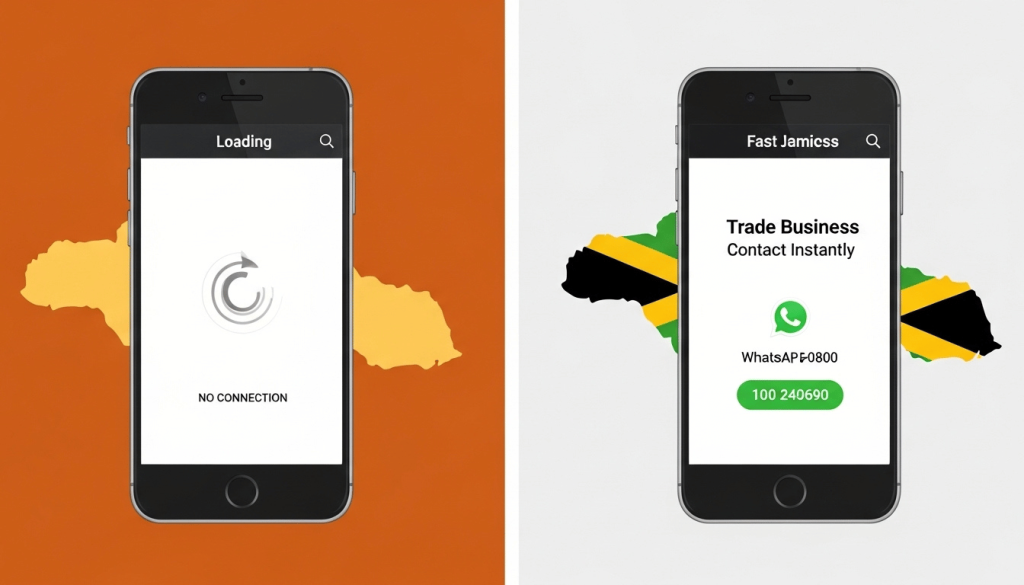
Your offline-first website should load instantly. Without it, your site shows a blank screen.
Your competitor’s loads instantly.
Guess which offline-first website gets the call?
Here’s the thing most contractors in Jamaica don’t think about until it’s too late: the moment the grid fails is often the exact moment a customer most urgently needs your services. A leaking roof after a storm. A flooded yard. A fence that came down. An electrical fault. These are not problems customers defer. They search for help right now, on low battery, with weak data, in chaotic conditions.
And if your website can’t perform in those conditions, neither can your business.
I’m Simmy Sterling, Content Alchemist at Digisolly. With over 20 years of Jamaican business experience in our corner, we spend a lot of time thinking about what it actually means to build a resilient business in this market. Today, we’re talking about a problem that is costing Jamaican contractors real leads: the offline-first gap.
What an Offline-First Website Actually Means
An offline-first website is not a website that works without the internet forever. Let’s clear that up immediately.
It is a website built with Progressive Web App (PWA) technology. That means it uses a technique called service worker caching to store your most important pages on the customer’s device the first time they visit. After that first visit, your site can load instantly, even on a poor connection, even during a power outage when mobile data is crawling, and even when cell towers are strained.
Think of it this way. A traditional website is like a shop that only opens when the road to it is clear. A PWA-powered website is the shop that delivers, even when the road is flooded.
For a contractor, the pages that matter most are your services page, your contact information, your location, your WhatsApp link, and your Google Business Profile call-to-action. Those are the pages a customer needs in an emergency. An offline-first build makes sure those pages load, no matter what.
Why Grid Failures Are a Jamaican Business Reality, Not an Exception
Jamaica’s power infrastructure is under documented stress. In September 2025, a technical failure at a liquefied natural gas facility triggered widespread blackouts that cut power to an estimated 95,000 customers across the island after a cascade of generation losses exposed vulnerabilities in the national grid. Jamaica Observer
That was not Hurricane Melissa. That was a routine infrastructure failure — and reason enough to invest in an offline-first website.
During Hurricane Melissa, the picture was far worse. Approximately 240,000 customers — 35 per cent of Jamaica Public Service’s customer base — lost electricity, with parishes like Hanover and St James among the hardest hit, where roughly 75 per cent of customers were without power. Jamaica Observer
The storm’s damage was concentrated in western Jamaica. But here’s the lesson that every contractor island-wide should sit with: disruption does not wait for permission. It arrives on an ordinary Wednesday morning, because an LNG plant in Kingston had a bad day. It arrives during hurricane season in St Elizabeth. It arrives whenever the grid is under load.
For working professionals and home-based business owners, a day without power can mean a day without income. For a contractor, a day with a slow website can mean a lost lead to the tradesperson down the road who invested in better digital infrastructure. Jamaica Homes News
The Lead You Lose Without Realising It
Here is what actually happens to businesses without an offline-first website during a grid failure or a network disruption in Jamaica.
Customers are on mobile data. Their signal is weaker than usual because cell towers are under load or have lost backup power. They are on 2G or 3G speeds, not 4G. Their phone battery is low. They are frustrated. They search for what they need and they click the first result that loads.
If your website takes more than three seconds to load under normal conditions, it takes much longer under those conditions. Research from Google consistently shows that more than half of mobile users abandon a page that takes longer than three seconds to load. In an emergency, with a dying battery and a half-bar of signal, that threshold drops even further.
You are not losing those leads to a better contractor. You are losing them to a faster website.
The good news is that this is entirely fixable. PWAs showed a 70 per cent increase in session length and a 20 per cent increase in page views per session compared to traditional web apps. More critically for trade businesses, they load faster under poor connectivity conditions. That is exactly the competitive edge a Jamaican contractor needs when the grid is struggling. Straits Research
What Resilient Digital Infrastructure Looks Like for a Contractor
Let’s be honest about what “resilient digital infrastructure” means in practical terms. It is not complicated. It is a stack of smart decisions, most of which can be made right now.
The five layers of resilience for a Jamaican contractor:
Layer 1: An offline-capable website. This is the PWA foundation discussed above. Your service pages, contact details, and WhatsApp link should cache and load without a full connection.
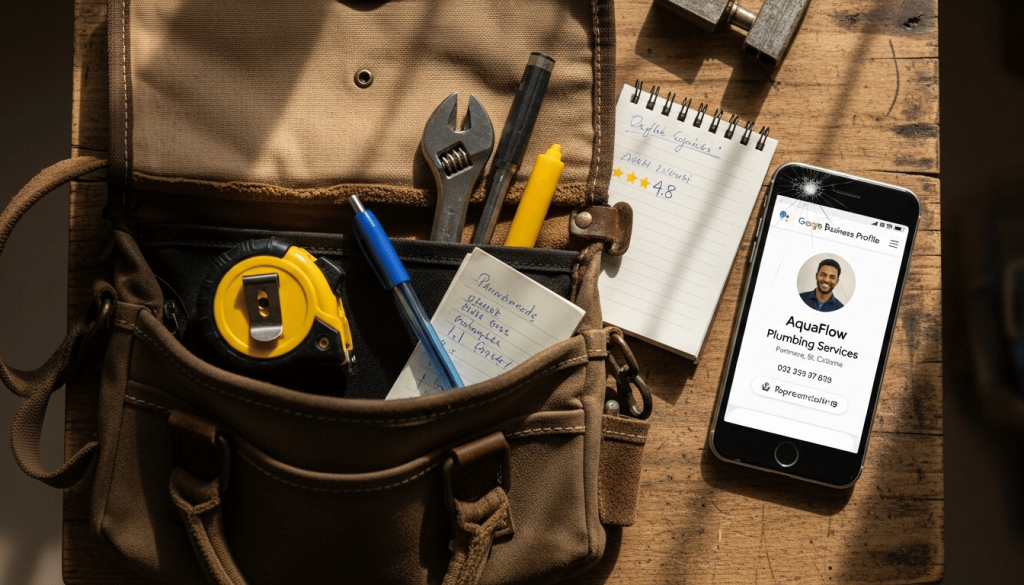
Layer 2: An optimised Google Business Profile. Your GBP is hosted by Google, not by your website. Even if your site is down, your GBP can appear in search results with your phone number, hours, and location intact. If your GBP is incomplete or unverified, you lose this fallback. The Google Business Profile Optimization: The Complete Guide for Jamaican Businesses is required reading before anything else.
Layer 3: A WhatsApp Business number. WhatsApp is how Jamaica communicates. During disruptions, data-light messaging continues even when voice calls fail. Customers should be able to tap one button on your website and land directly in a WhatsApp conversation with your business.
Layer 4: Cached contact information. Your phone number, your service area (parish-specific, always), your working hours, and your emergency availability should be in your website’s metadata and GBP so they can be read by Google, by AI tools, and by customers who saved your page weeks ago.
Layer 5: Reviews and trust signals. When a customer finds you during an emergency, they make a fast trust decision. Five recent Google reviews with specific parish mentions — “fixed my roof in Westmoreland the next morning” — do more work in that moment than any tagline you’ve written.
The Connection Between Offline-First and AI Search Visibility
Here’s the part that surprises most contractors, and it shouldn’t.
Google’s search algorithm rewards fast-loading, technically sound websites. But what a lot of business owners don’t know is that AI search tools, including Google’s AI Overview, ChatGPT, and Perplexity, also favour businesses whose digital information is structured, stable, and consistent across platforms.
A slow, unreliable website sends a signal to AI systems that your business information may be incomplete or untrustworthy. A fast, offline-capable site sends the opposite signal. It says: this business has its house in order.
Google bots can index PWA content even in offline conditions, which improves visibility in search results. In other words, building for resilience and building for AI visibility are not separate projects. They are the same project. The Software House
If you want to understand how AI tools decide which local businesses to recommend, the What Is AEO? A Guide for Jamaican Businesses is the place to start. It explains how Answer Engine Optimisation works and why structured, reliable content is the backbone of AI-era visibility.
A Practical Checklist: Is Your Contractor Website Grid-Resilient?
Run through this before hurricane season opens on June 1.
Website performance:
- Does your website load in under three seconds on a mobile connection?
- Has a developer assessed whether your site uses service worker caching or PWA technology?
- Do your service pages, contact details, and WhatsApp link load even on a poor connection?
Google Business Profile:
- Is your GBP fully verified and up to date?
- Does it list your correct service area by parish?
- Does it have at least five recent reviews that mention specific locations and services?
Contact accessibility:
- Is your WhatsApp number clickable directly from your homepage?
- Is your phone number in plain text, not embedded in an image (which cannot be read by AI tools)?
- Are your emergency hours, if any, listed somewhere on your site?
Offline preparation:
- Have you tested your website on 2G or low-signal conditions using a browser developer tool?
- Do you have a Google Business Profile post live, in case your website is temporarily unavailable?
If you answered no to more than two of these, your business has a grid-resilience gap worth closing before the next disruption arrives.
Frequently Asked Questions: Offline-First Websites for Jamaican Contractors
What is an offline-first website and how is it different from a regular website? An offline-first website uses Progressive Web App technology to cache your key pages on a visitor’s device after their first visit. If their connection drops or weakens, the cached version still loads. A regular website requires a live connection to function fully. For contractors whose customers search during emergencies and outages, the difference can be the difference between getting the job and losing it.
Does an offline-first website cost significantly more to build? Not necessarily. PWA capabilities can be added to many existing websites through a developer, rather than requiring a full rebuild. The investment varies, but the cost of a single lost emergency job almost always outweighs the cost of the upgrade.
Does this help me show up in AI search tools like ChatGPT or Google AI Overview? Yes, indirectly but meaningfully. AI search tools favour businesses with technically sound, consistently accessible digital profiles. A fast, well-structured PWA site improves your overall digital trustworthiness, which is one of the signals AI tools use when deciding which businesses to recommend.
What parishes in Jamaica are most at risk from grid failures? Based on the impact of Hurricane Melissa, parishes in western Jamaica, including Hanover, St James, Westmoreland, Manchester, and St Elizabeth, experienced the most severe and prolonged outages. However, island-wide grid events, like the LNG facility failure in September 2025, show that no parish is exempt from disruption.
Can I do anything right now, without a developer? Yes. Start with your Google Business Profile. Ensure it is fully verified, that your service area lists specific parishes, and that your phone number, hours, and WhatsApp contact are accurate. Then check your page load speed using Google’s free PageSpeed Insights tool. These steps cost nothing and close two of the five resilience layers described in this article.
The Resilience Advantage Is Still Available
Grid failures are not going away. Jamaica’s power infrastructure is improving, but the honest assessment, supported by the September 2025 island-wide outage and the sustained disruptions after Hurricane Melissa, is that contractors need digital systems that perform when the grid does not.
The contractors who build offline-first websites right now are not doing something extraordinary. They are simply doing what their competitors have not done yet. And in an emergency search, being the fastest to load is often the only distinction that matters.
At Digisolly, we help Jamaican businesses build the kind of digital presence that works under pressure, not just on a good day. If you want to know where your business stands right now, start with our free AI AI Visibility Scan. It will tell you, quickly and plainly, what is working and what needs to change before hurricane season opens.

Simone “Simmy” Sterling is the Content Alchemist at Digisolly, writing about AI-first digital strategy for Jamaican small businesses. She turns the complexity of AI search, Answer Engines, and digital visibility into plain language that actually makes sense, and actually gets used. Think less tech jargon, more real talk over a good cup of Blue Mountain.